
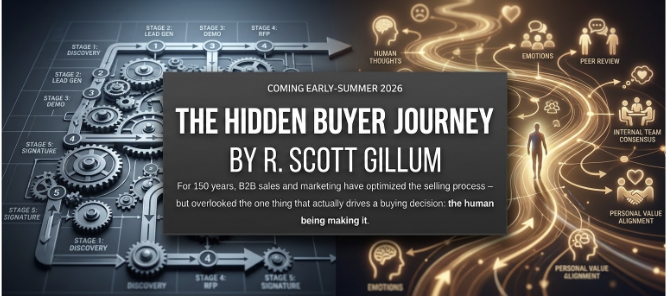
This post is an excerpt taken from the upcoming book The Hidden Buyer Journey, to read more click here.
Here is a question worth sitting with: if a researcher called your customers tomorrow and asked them about their buying experience, would they mention you by name?
Not your company. Not your product.
You, specifically. By name.
For most sales professionals, the honest answer is probably no. And that’s not an indictment of their effort or their intentions. It’s a reflection of how B2B selling has been structured for the past two decades — around process, pipeline stages, and quarterly targets rather than around the human being on the other side of the deal.
Ben is the exception that proves the rule.
We Weren’t Looking for Ben
We didn’t go looking for Ben. We were conducting customer research for a private equity firm that had acquired several companies and was evaluating how to consolidate their brands. The goal was straightforward: interview existing customers, understand the strengths and weaknesses of the brand, and surface the insights that would inform the go-forward strategy.
We interviewed dozens of customers across multiple acquired companies. We were asking about brand perception, buying experience, product satisfaction — the usual territory. And then something unusual started happening.
A name kept coming up.
Not a product name. Not a company name. A person’s name. Ben.
What made this remarkable wasn’t just that customers remembered him. It was that they remembered him across companies he had never officially sold to. Ben sold products across three of the acquired businesses. But his name surfaced in interviews with customers of all of them — including ones where he had no formal relationship, no account ownership, no territory.
In years of conducting this kind of research, we had never seen anything like it.
What Ben Actually Did
When we dug into why customers kept mentioning Ben, the picture that emerged wasn’t what you might expect. Nobody talked about his pitch. Nobody mentioned his product knowledge in the traditional sense. Nobody brought up his closing technique or his follow-up cadence.
What they talked about was what Ben did for them.
The product team at one company described how Ben had worked directly with their engineering team during product design — showing up not as a vendor trying to protect a sale, but as someone genuinely invested in making sure they had the right components for what they were building. That’s not in anyone’s job description. Ben just did it.
The procurement team at another company explained how Ben had somehow created a consolidated invoice that allowed them to manage purchasing across three separate business units — something the selling company didn’t actually offer as a service. To this day, we’re not entirely sure how he pulled it off. But he did.
And a third company’s buying team simply said: “Ben actually answers his phone.”
That last one landed hardest. In a world of automated sequences, CRM-generated follow-up tasks, and carefully managed response windows, the fact that a human being picked up the phone when you called was memorable enough to mention unprompted in a research interview.
What Ben Was Actually Selling
Here’s the thing about Ben that the traditional sales framework completely misses: he wasn’t selling products. He was selling something far more valuable and far more difficult to replicate.
He was selling himself as the most reliable, knowledgeable, responsive partner his customers had.
The consolidated invoice nobody asked for. The engineering conversations nobody else was having. The phone that actually got answered. None of that appeared in a product brochure. None of it showed up in a CRM field. None of it would have been captured by any intent signal or engagement metric in any marketing platform.
All of it was what kept his name coming up in interview after interview, across companies he’d never even officially sold to.
Ben had figured out — instinctively, without being taught it — that his job wasn’t to sell. His job was to make it easier for people to buy. And in doing so, he had built something that no competitor could undercut on price, no algorithm could replicate at scale, and no automation could replace: genuine trust.
What the Research Tells Us
Ben’s story isn’t just a feel-good anecdote about a talented rep. It’s evidence of something the research confirmed repeatedly across thousands of buyers in fifteen industries.
When customers are asked what actually drove their purchase decision, the top three answers — product quality, usability, and value — are things they can only experience after they’ve already bought. Which means during the sales process itself, they’re not evaluating the product. They’re evaluating something else entirely.
They’re evaluating Promise. Credibility. Trust. And whether the business argument being made feels honest rather than optimistic.
None of those are rational calculations. All of them are emotional judgments about the person in front of them. A buyer doesn’t calculate trust. They feel it. They don’t measure credibility against a rubric. They sense it in how a rep shows up, how much they know, how well they listen.
Ben understood this without being taught it. He wasn’t operating in a machine-to-human world, sending triggered sequences to a list. He wasn’t in a human-to-machine world, entering data and working algorithm-generated queues. He was doing something far simpler and far more powerful.
He was being human, to another human.
The Question Worth Asking
The B2B industry has spent the better part of two decades building systems designed to scale the sales process — to remove the inefficiency, the unpredictability, the human variability from the equation. And those systems have produced exactly what you’d expect: a selling environment where 61% of buyers say they’d prefer a rep-free experience entirely.
Ben is the argument against that trajectory. Not because he was operating without technology or process. But because he never let the technology or process become the point. The point was always the person on the other side of the conversation.
In our research, the most effective predictor of whether a deal closes isn’t the strength of the product, the competitiveness of the pricing, or the sophistication of the marketing automation. It’s whether the buyer trusts the person making the promise.
Ben built that trust across three companies, in an organization he only officially worked for one of, with customers who remembered his name years later in a research interview nobody told them was coming.
That’s not a sales technique. That’s a human one. And in a world that is rapidly automating everything else, it turns out to be the most competitive advantage of all.


