by scott.gillum | Sep 21, 2012 | 2011, Marketing
This post was originally posted on July 8, 2011. It also appeared on Forbes.com
Here’s a hypothesis: Given the greater focus on ROI, marketing automation tools, and enhanced tracking of results, marketing is more of a science than ever. Therefore, marketers’ ability to defend and validate their value among peers should be easier than ever before.
So why does a recent study by Fournaise show that CMOs still lack credibility with CEOs?
The study points to several deficiencies with an emphasis on communication – are you sensing the irony? Further, marketers tend to sabotage themselves in everyday interactions with the larger executive team, and in many cases, have no idea they are doing it.
Here are five common mistakes among marketers:
- Stumble explaining the value of marketing. Asked almost daily, and rarely answered properly. The key is to understand how the inquirer perceives the role of marketing. The question behind the question is “what is the value of marketing … to me?” According to the study, it most often relates to “revenue, sales, EBITA or even market valuation.”
- Limited product, service, and customer knowledge. Even the savviest marketer will arrive DOA in the credibility department if they fall short on this one. And it is not about feature or functionality, but rather customer use and application that matter most and those factors vary by industry and size. Leave “speeds and feeds” to the product organization. Marketing’s job is to differentiate and develop compelling value propositions that sell. If products are built “inside-out,” then bring the “outside-in” perspective.
- Can’t Dance. Marketing comes with highly visible risk and things are going to go wrong. When they do, marketing needs to learn how to dance. Handling these situations will define how marketing is viewed. Keep best and worse case scenarios in mind when briefing the executive team. Truth is, if marketing isn’t making a few strategic and tactical mistakes, it’s not moving fast enough. As a former IBM client told me, “If you fail, and you will, fail fast.”
- Isolation. A favorite question from sales: What have you done for me lately? And the product team can be equally demanding. However, marketing has to build, nurture, and maintain strong relationships with these groups. For Sales, it is helpful to establish an integrated sales pipeline and hold weekly pipeline meetings; this will build rapport and create a common sense of purpose. It’s also an opportunity to put marketing metrics in a sales context. The key to a successful relationship with sales is about communication and performance. For the product group, marketing needs to clearly define points of integration for research, content, and value proposition development. The key to a successful relationship with the product team is about process and integration.
- Where to invest – or cut – an incremental dollar. This question is posed by the CFO at the end of the quarter when numbers are off, and by the CEO who wants to redirect budget. It’s also used as a test. As a holder of discretionary dollars, marketing has to be prepared to answer “where” and “why” along with stating the business impact. In talking about CMOs, 72% of CEOs say, “[marketers] are always asking for more money, but can rarely explain how much incremental business this money will generate.”
To call out the sense of irony, most of these issues are communication related. The same rigor brought to external communication needs to be applied internally:
- Know the audience
- Understand their needs
- Communicate to them in their language.
While the Fournaise study states that executives think in terms of “revenue, sales, and EBITA,” most make judgments based on their emotions. Marketers are advised to use their creativity in delivering the message.
Friedrich Nietzsche said it: “All credibility, all good conscience, all evidence of truth come only from the senses.”
by scott.gillum | Aug 20, 2012 | 2012, Marketing
Everybody knows – or thinks they know intuitively – that social elements add value to marketing. The question is how?
Like anything in business, it comes down to return on investment. Social media is not a strategy and it’s not an end in itself. Unless your business objective (and I’d check with your shareholders on this) is only about gaining page views and follows, marketers need to understand how social adds value to everything else in your toolkit.
So how do you find the “sweetspot” for developing an ROI for social media? Well, start by viewing the tools at their most basic level, as vehicles for sharing and; photo’s, thoughts, content, etc. Consider them “levers” for improving the performance of known activities that have produced a ROI.
Five years ago, we assessed the effectiveness of demand generation campaigns for a client. Because the firm was in the hi-tech industry they had a heavily reliance on content marketing for their campaigns. They spent months designing and building them, and hundreds of thousands of dollars in execution only to see diminishing results.
The audit revealed that their campaign effectiveness (related to lead production) lasted roughly 36 hours after launch (see below). Meaning that the majority of the leads were being created within the first three days of launch, regardless of how long they left the campaign in the market (btw – they are not alone).
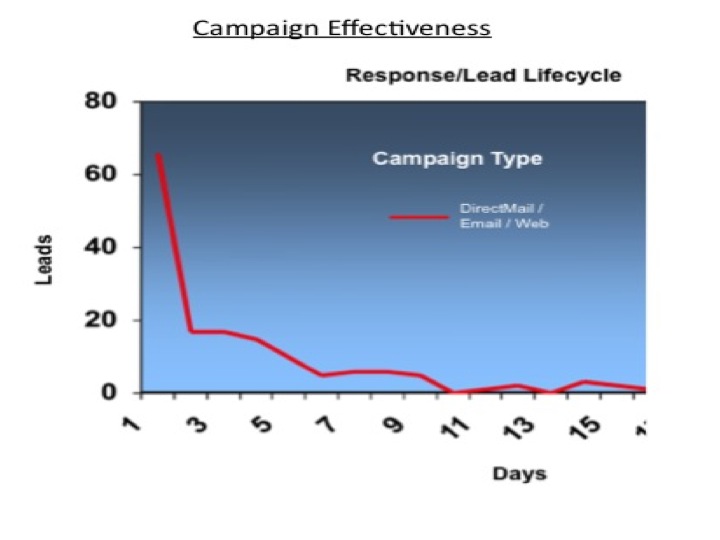
Today, social media has the potential to create a long tail, extending the life of expensive campaigns, ultimately improving ROI, and along the way creating and deepening the relationship with the audience.
I’ll use myself as an example: A blog post of entitled The End of Blogs (and Websites) as We Know Them ran recently in on Forbes. It received no special promotion; in fact, you could say the deck was stacked against it. Posted on a Friday, the slowest traffic day of the workweek, at midnight (EST) when most of the blog readers at home or are in bed. By prime blog viewing time (10 am) it had almost dipped below the fold.
But on the following Monday it took off, almost doubling the views of Friday, and continued to build momentum ending the week as the 3rd most popular post of the day. The following week it was the most popular post on Wednesday. So what happened?
Social took over. Without any additional investment to promote the post, social sharing accelerated and extended the life of the post, even as it fell off the first, second and third page of the site. Readers engaged and went from passive viewers to active promoters.
Readers were tweeting their own thoughts and comments about their insights, not just retweeting the post title. They placed in into Linkedin groups adding their comments on the impact of the technology (the topic of the post) to their particular area of interest or role. They were actively engaging in sharing their “discover” with others.
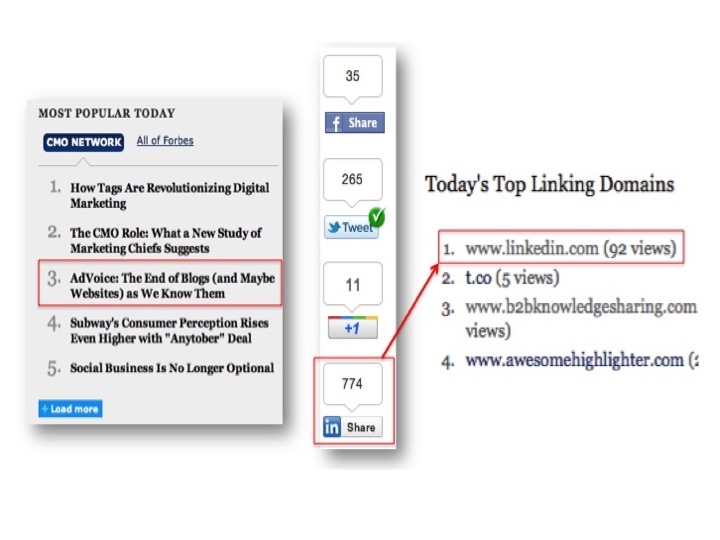 That is the power and the value of social media for content marketing.
The post no longer needed to be pushed because it was being endorsed, and in some ways validated, by readers — the most trusted source of information.
The potential of social media is intriguing, but to determine its true value companies will need to experiment. Using social media to support your content marketing efforts is a prudent choice, but keep this in mind: It will only be effective if the audience/community finds value in the content and part of that value is defined by those who pass it along.
by scott.gillum | Aug 10, 2012 | 2012, Marketing
In 2004, I was part of research project with a professor at the Kellogg School of Management and the CMO Council that sought to understand what CMO’s believed to be critical for their success. The most common response was a seat at the table with other senior executives.
Four years ago, I was part of another research effort focused on the CMO’s top priorities, and number one on the list was to be viewed by their peers as strategic thinkers. Finally, I believe the day has come for that to happen.
Marty Homlish, the CMO of HP believes the line between business and consumer marketing is disappearing. Homlish states, “ Behind every B-to-B company is a consumer. The way you communicate to that person is as an informed consumer.”
Technology has allowed work to follow us home and our home life to the office. It has blurred the line between our personal and business personas. The concept of being ‘at work’ is now more a state of mind rather than a physical location or particular time of day.
If business buyers – who were once thought of only as rational decision makers – now need to be communicated with as informed and emotional consumers who no longer fit our past perception of work hours and locations, what might this mean for the future of business-to-business marketing?
To answer that question, one must first understand the difference between how business and consumer marketing operate. According to a Booz & Co and the ANA in The New B2B Marketing Imperative study, B2B marketing has primarily taken an “inside out” approach, focused on the needs of the company and accounts rather than customers.
By contrast, 85% of B2C marketers, who take an “outside in” approach said they were involved in growth initiative decisions which are considered to be strategic such as new market entry, customer relationships and market driven product development.
Additionally, 42% of B2C marketers play a key role in building customer relationships, versus 8% of business marketers. B2B marketers said that “Customers are rarely driving the process and their input is seldom integrated from end to end.”
If today’s business buyers really are “educated consumers” as Homlish suggests, then business marketers can no longer be left out of customer and product conversations. It also means that organizations that target business buyers, who has given lip service to transitioning from being “product led” (inside out) to “customer focused” (outside in) now need to act. And the tip of the spear for driving that change – is marketing.
By better understanding and influencing the needs, desires and emotional drivers of individual business consumers, marketers will be in the strategic conversation and lead the transition. This is the key to unlocking the executive suite.
However, the organization is not just going to give marketers a seat at the table and there is a good possibility that executives don’t get it. As one of the marketing directors said in the study; “Marketing is just not in the DNA of senior management.” You will have to make it happen.
The study concludes that; “Core marketing capabilities – those that directly influence customers – have the highest correlation to market share growth.” Senior executives may not understand marketing but they do understand growth.

by scott.gillum | Aug 3, 2012 | 2010, Marketing
Original post date May 2010, the post was recognized as one of the best post on Social Media for 2010.
As with most new technologies, social media is starting to “settle in” and common applications of the platforms are becoming known. In many large B2B organizations, that means social media is finding a home in the marketing communications group, often landing in PR.
That seems fine for B2C organizations; however, I’m not convinced that it’s the right spot, and/or the only spot for social media in B2B companies.
The Upside Down Funnel
In most B2B organizations corporate marketing’s role is related to driving “top-of-the-funnel” activities. From advertising, PR, and now social media, the focus is on creating awareness…and hopefully, driving consideration and preference. There is another opportunity that may not be considered, a part of the funnel where marketing, in particular social media, can play a valuable role.
It’s at the very bottom of what I’ll refer to as the “upside down” funnel. To find such an opportunity you have to think about a funnel that starts with once a prospect becomes a customer.
Just as a sales funnel has stages so does the customer relationship management process. Companies should be actively pursuing strategies and tactics to retain, expand, grow and then leverage customer accounts to win business.
This is where I think the “sweetspot” is for social media in B2B. Here’s why: social media is about “consumers selling to consumers”, or “professional-to-professional.” If a company does its job of nurturing and retaining customers, it should be able to transition from having a relatively unknown prospect, to a known customer, to hopefully, a well-understood customer advocate…at least that’s the goal.
The Opportunity
If a company enables those customer advocates with social media it gives them a platform to spread the good word. The potential of this opportunity is huge, and for the most part, being missed at most companies today.
As we all know, word of mouth is the most effective marketing there is, enabling it with technology creates scale, and the ability to track it.
To do this successfully, companies have to first identify this opportunity within their organization; second, they have to change their current way of thinking about social media beyond its present use in marcomm and PR.
It means finding uses and opportunities within sales and customer service. Yes, listening to customers chat about your service on Twitter is important, but I’m talking about creative ways to use it for:
- customer-to-customer referrals & recommendations
- building communities
- facilitating discussion groups
The goal is to find ways to emotional connect avid customers to the company and/or products, and then provide them with an outlet to communicate that passion.
What to Do
As relationships deepen, customers begin interacting in more personal channels. Through those interactions they are likely to share more intimate details about themselves, and their relationship with products/services and the company.
Companies have to be able to collect this information across channels to create a complete profile of a customer. If this can be achieved, an organization will have everything it needs to begin enabling, influencing and studying customer advocates.
Finally, watch out for the “silo” effect. Typically, at least three different organizations will be interacting with the customer as the relationship develops. But it’s only one customer interfacing with what the customer expects to be one company. The organization has to be “in sync” because the last thing a company wants is to provide a customer with a platform for communicating the wrong message. Turning an advocate into an adversary is not the goal.
by scott.gillum | Aug 1, 2012 | 2010, Marketing
Original post date December 15, 2010
Last month I had the chance to be a panelist at a forum hosted by Wolfgang Jank and the Robert H. Smith School of Business at the University of Maryland. The topic was on Informatics – Data Driven Decision Making in Marketing.
Agreeing to participate without knowing what I would discuss, I searched my files reviewing old project work. Not only did I find a relevant effort, I also realized that I had spent two years working on building and implementing an insights program at a major Financial Services firm.
What’s interesting about the topic is that everyone will agree that they should be more data driven, or fact based, with their decision-making. Heads will nod when it’s discussed, it’s intuitive, and so the question…and the problem, is why doesn’t it happen?
The company I was working with had an abundance of data but were faced with two consistent problems related to the use of it:
- Reps wanted better insight
- Customers wanted a POV
The first issue we probably spent a good six months on defining what an ‘insight” was, how to create it, and who was responsible for doing it. The second issue was more complicated, and took much longer to resolve.
Over that two-year period, I learned how challenging it is for an organization to use one source of data effectively across the enterprise. Some of the challenges we uncovered were typical such as lack of resources, process, and funding. Others were more challenging: People funded their own resources and research to support their strategy, budget or group.
To begin to solve this complex problem we created a “data value chain” (see below). The starting point was having one centralized source for data. As we discovered, as data flows from across the organization to the customer, enhancements were needed to make it more valuable, like growth rings on a tree.
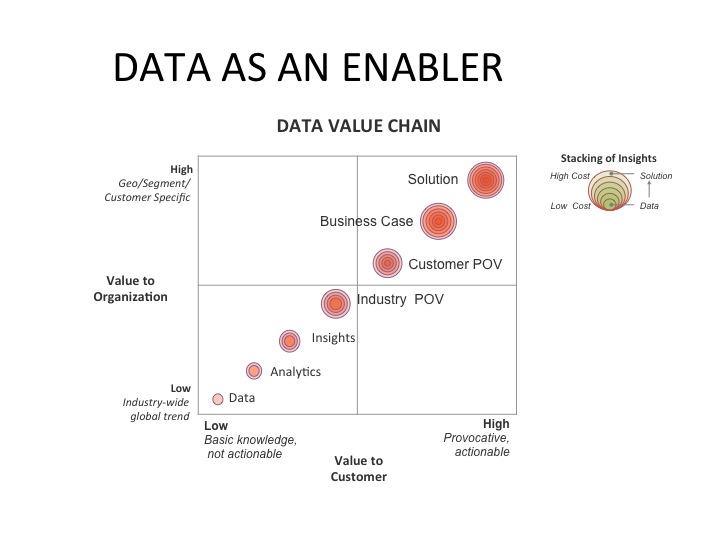
As data became more customized, and localized, it grew more valuable. This helped to identify why, for example, research that was being produced at corporate was not often used by the sales teams…it lacked relevancy, especially in regions outside of the US.
Once we got everyone on the same page the next challenge was to align the various groups in the organization across the value chain. We learned there could be as many as five different groups involved in handoffs as the data moved across the value chain. This help to explain why product groups were developing solutions without market insights, and regions were not leveraging corporate insights for business development.
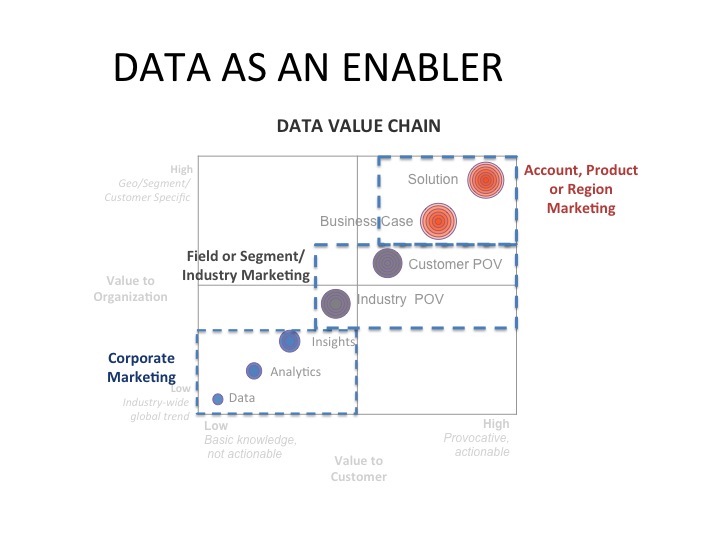
Handoff points in an organization
As a result, we had to design process maps, hand-off points, engagement process, etc. The elephant in the room, and one of the biggest challenges was wrestling with the budget. The solution for that last huddle was turned out to be pretty simple.
The corporate “insights” team would work with those regions that wanted to work with corporate. Those regions had to be willing to fund resources to finish the “last mile”…building a solution or a customer business cases with a defined solution in mind. Even though everyone wanted more relevant insight, and more defined points of view, not all regions were willing to pay for it. Finally, to secure the funding to make the fixes we had to be able to answer a very simple question; “how does being more data driven provide value to the organization?”
The answer was getting the data closer to revenue or a sale….”turning data into dollars.” The epiphany wasn’t that the value was found at the end of the chain but the number of groups, and the coordination needed to be involved to reach that destination.
by scott.gillum | Jul 30, 2012 | 2009, Marketing
Original post date July 16, 2009
I’m about to share with you the secret formula for; 1) creating a rock solid, compelling value proposition (for products, services, solutions, etc.) and, 2) aligning (enterprise wide) your corporate communications. It will seem like a very simple approach, and it is, but once you try to get consistent answers from the organization to the following questions (in order) you will understand why this is so challenging…and why so many companies fail.
Keep this in mind, effective communication to customers must happen through a consistent delivery of the right message, to the right customer, at the right time, in the right channels to facilitate effective, efficient dialogue.
This is how you do it. You have to be able to collectively (with the right internal groups) answer the following five questions in order:
- Who? – what audience/segment are you targeting, and why
- What? – what do you want/have to say to that segment that is relevant
- Why? – why would they listen
- When? – when do you contact them, and how often
- Where? – where do they want to receive the message
Sounds simple right? Here are a list of challenges you will face when go through the process:
- Who – right off the bat, you will find folks arguing about your target audience, the segmentation approach, the segments, etc.
- What – oh, you’ll have plenty of things you what to tell whatever audience you settle on but you will struggle with relevancy
- Why – now comes the killer question…why would they listen? Seen this question bring grown men (and women) to their knees. The reasons are many; Marketers don’t understand the products, products aren’t differentiated, etc. Getting this question right is the key to the whole process.
- When – the challenge is deciding on at what point in a sales process, a marketing campaign, events, etc., and the frequency of contact. Touch them too often and/or at the wrong point you’ll get opt-outs, too infrequently, you’ll get no mindshare.
- Where – notice that I said, “they”, and not “you” on where the communication happens. Yes, it’s about your customer and where they go for information not where you want to put it. Find out where your audience goes to get information and/or determine their perference for receiving it. The othe challenge is ensuring that the message fits the channel. Certain messages/value proposition, etc. fit a certain channel better than others. It’s worth the time to figure this out.
This approach creates an execellent output but it will take time, discipline and many iterations to get right…good luck.


