
by scott.gillum | Mar 4, 2019 | 2019, Entrepreneurship
The following is an excerpt from an interview on Superbcrew.com
Could you provide our readers with a brief introduction to Carbon Design?
We address a set of business problems that clients have historically pursued through relationships with management consulting firms or marketing agencies.
What’s different is the way we approach these problems. Rather than starting with the assumption that we have just the right IP, just the right methodology, or just the right team, we start with the assumption that none of that might be the case. That leads to a different business model, and very different client experiences – from beginning to end.
How so?
Clients can bring us in as early as they want – especially, when the nature of the challenge is still up in the air. Since we draw on a broad set of experiences, but don’t have anything we need to sell, we’re a trustworthy helper to facilitate problem formulation and solution ideation.
Then, if execution is needed, we can look into our network of freelancers, boutique firms, side-giggers, and design a delivery model that works for that particular solution.
So what exactly does Carbon Design do?
We’re definitely a thinking partner. Our approach is to help our clients look at problems from a more varied set of perspectives. And we do frequently provide a spectrum of marketing services from go-to market strategy and brand development to creative asset development. But, because we got rid of the burden of staff cost and the overhead of a traditional agency or consulting firm, we can offer clients agility and good value, and still run a profitable business.
How does your approach differ from any of the “Let us find a specialist for you” platforms?
If you need an uber, it probably doesn’t matter all that much who’s driving. If you need help with innovation, it absolutely does. So we’re not a platform – or at least not in the sense of some sort of algorithm-driven matching of supply and demand.
We execute projects and provide the right people and the right fit for the task. We can do that because I personally know every one of our specialists and know them quite well. I know what they can do, what they’re great at, and what areas they’re not suited for.
Look: Assembling a skilled team for a tight-focus and probably time-critical job isn’t something an algorithm can do well, any more than it’s something that can be solved by a large agency putting people with “free time” (an odd term for someone who’s time is billed—and marked up—by the hour) on a job simply because they’re “available.”
We get to know the client as well as the client’s problem. Then we bring in the people we know will be best-suited to the job.
What are people saying about their experience with Carbon Design?
Here are three verbatims I recall that might be helpful in painting that picture:
“You guys ask the right questions.”
“ I hired you because this problem wasn’t ready for me to give to my agency.”
“Thank you, we learned a lot.”
Generally the feedback usually falls in two camps. The first, is related to our operational flexibility – a kind of “Ocean’s 11” approach to building executional teams. And the other has to do with our mental flexibility – we’re seen as creative thinkers who bring out that same quality in our clients.
Other client quotes and comments are available on our website.
Who are the primary users of Carbon Design?
A few patterns are emerging: We tend to be championed by people well-placed in the sales and marketing organization, but we find ourselves speaking with CEOs, more often than we expected. .
Our clients know they have an issue. It’s why it hasn’t been solved that starts our journey. In our experience the obvious problems are typically an iceberg with a large amount of complexity under the surface. Our focus is to get inside the heads of organizations and audiences, to understand the WHY, not only of the problem, we’re brought in to solve, but also the WHY of the resistance.
We tend to connect with people who don’t shy away from complicated challenges, and who appreciate the role of experimentation as a method of learning about them.
And – we seem to be on a streak of connecting with people that are trying to do things that are genuinely new.
What are some of the key challenges you are helping clients solve?
In healthcare, we’re working with an organization to develop more effective means of reaching and influencing high-risk patients.
With one of the world’s leading environmental design and engineering firms, we’re helping to invent an entirely new category in housing (and all the infrastructure related to housing).
For the food service industry we’re working to redefine and re-educate the industry and its customer — on the sources of outbreaks in restaurants.
In the software as a service space, we’re helping an exciting machine-learning brand develop their brand positioning and go-to-market strategy.
I will say that in all these cases, it was our work in helping with understanding the root cause of the problem itself that was critical in the outcomes obtained in execution. .
What are your plans for the future?
We want to give talented people a chance to change they way they work.
Obviously we want to continue to grow as a business, but one of requirements we placed upon ourselves when we created Carbon Design, was that we would walk the same walk that we talk.
So our growth plans and our growth curve with luck—will be as natural and sustainable and as liberated as our approach to our talent. Don’t look for us to have vast, shiny office spaces and expensive back-office staffs any time soon. Or ever.
Do look for us to scale up as opportunity (appropriate opportunity) presents itself. We’re already a global operation that does things better.
Industrial Revolution. Digital Revolution. Work Revolution.
I’m not entirely joking.
Stay connected with Carbon Design Co. by joining our email list here!

by scott.gillum | Nov 5, 2018 | 2018, Opinion
We really didn’t know what we were doing to start — still not absolutely sure now. All we had to go on was a folder full of research and some insight from a bunch of conversations. What we did know was that something had shifted, really talented people were leaving the “traditional” workplace.
The data point that stuck in our heads was that by 2027 more people will be working independently (for themselves) than for companies. Not surprisingly, Gallup found that 87% of employees are not engaged at work. I personally witnessed this migration in advertising with some of the best talent walking out the door to set up their own shops.
Millennials approach work, and view success, very differently than my generation. They have wholeheartedly embraced “gigging,” with 1 out of 2 engaged in some side hustle. The concept of “work” has changed but few companies have taken notice.
Armed with these observations and information, we launched Carbon Design, a talent platform aimed at providing individuals with an opportunity to work how they want, when they want, where they want, on projects of their choosing. On Halloween, we celebrated our first anniversary. It’s been an interesting and exciting year.
Although our organization is still evolving we’ve learned 3 important things about how work and workers have changed.
The Secret Economy
There is a tremendous amount of under utilized talent in the 9 am to 2 pm economy. In fact, more than 11 million Americans stay at home with their children. A Reach Advisors study found that found 57 percent of moms would like to go back to work at some point.
The people we’ve worked this year have left executive positions at Fortune 500 companies, partner positions at management consulting firms, and leadership roles at big network agencies to pursue their entrepreneur instincts, take care of a sick parent or nurture their children. They seek to work part-time, 20 hours a week and often put in 40 but it’s THEIR choice, and that makes all the difference.
Life-Work Balance
For years, I witnessed co-workers move to part-time after the birth of a child. Eventually, they would end up in my office feeling like they’re weren’t doing a good job being a parent and/or valuable contributor to the team. If fact, they felt they were failing at both, finding it difficult, if not impossible, to balance the demands of work and life.
After spending a year with people who’ve seemingly figured it out, there is a common thread they put the priority on life, and then work. Getting, or having their life in order by focusing on their most important priorities allows them to then use their time efficiently for things they want to do creating both a sense of control and peace of mind that results in happiness.
As Professor Daniel Sgrio of Warwick University found in his research on Happiness and Productivity, “The driving force seems to be that happier workers use the time they have more effectively, increasing the pace at which they can work without sacrificing quality.” In fact he found that happy people are more productive workers, 12% more according to the research.
Workspaces and Workstyles
Last week a colleague and I were onsite with a client. They had just moved into a new location and spared no expense to make it a great work environment. Lots of natural light, adjustable workstations, a cafe, top of the line espresso machines, craft beer on tap, and game area, etc. On our way out my colleague, who I worked with in an open office space with similar amenities said; “I don’t think I could it.” To which I responded, “Do what?” and he said “Work in an office anymore.”
My colleague is not alone in his feelings. Recent research has shown that open office spaces have failed, but that’s not the real issue. Given how unique people are (and their work habits), it seems naive to think that one type of office could possibly make everyone happy and productive.
In fact, more than 14,000 people have taken the online test “Is Your Personality Suited To Working Remotely Or In The Office?” The test revealed that only 24% of people who work in an office say they love their jobs, compared to 38% of mobile workers and 45% of telecommuting workers.
Additionally, Stanford economics professor Nicholas Bloom fascinating research (and entertaining TedX Talk) found employees working from home were more productive, more engaged and less likely to quit. He debunks the myth that remote workers are less productive. But as Dr Bloom points out in his research, not everyone was happy working that way.
The point is, working in an office, no matter how nice, will only fit the needs of a portion of the employee base. Our network of talent work from whichever location fits their life that day. It could be a shared workspace, a coffee shop or their child’s school cafeteria. Their office is “on demand” requiring no travel. Now, compare that to the one hour commute (each way) I had last year to get my office. By that math, they’re already 20% more productive than I was as an office worker — and a lot less stressed out!
Pursuing Happiness
What the research and our experience this year has shown is that the tradition idea of work — the M-F workweek, 8 am to 6 pm office hours, in an office are increasingly at odds with creating a productive, engaged and happy workforce.
With the rise of video and cloud based collaboration tools, talent is finding ways to work that better align with their work styles. Instead of bending their schedules around work, they are finding way to flex work around their lives.
For years we have been trying separate our work and our personal life when in reality, they are one thing.The people we’ve work with this year seem to recognize that work, like health, family and happiness, are all intricately tied together.
Getting life right, whether it’s planning your schedule to attend your son’s baseball game on time, or working from home to care for a loved one who’s sick, is different for everyone. Whatever getting life right is, as long as it’s first, everything seems to fall into place.
As educator and author Bob Moawad states; “The best day of your life is the one on which you decide your life is your own. No apologies or excuses. No one to lean on, rely on, or blame. The gift is yours – it is an amazing journey – and you alone are responsible for the quality of it. This is the day your life really begins.”

by scott.gillum | Feb 8, 2018 | 2018, Business Trends
In the 90’s casual Fridays brought about the slow death of formal business attire in the office place. In the new millennium, mobile devices effectively eliminated the “9 to 5” workday and erased the line between personal and professional. Now, the “Gig Economy” is about to kill the concept of a company employee.
The freelance workforce is growing three times faster than the U.S workforce. At this rate, according to a recent survey by Upwork and the Freelancers Union, independent workers will be the majority by 2027. Yes, more people will work for themselves than for corporations, and they will be doing it because the want to…not because they have to.
The work is not what you would think of as typical “gig economy” jobs, e.g. an Uber driver. According to the FIA survey of close to 6,000 adults, this group is preparing for the future more swiftly than traditional employees. Nearly half of the freelancers surveyed told researchers that their work is being impacted by AI and robotics (only 18% of the traditional workforce). As a result, 65% are staying on top of the latest trends and are putting time aside to learn new skills, compared to 45% of traditional corporate employees.
As a result, this specialized workforce is finding independence because it is developing high demand, hard to find skill sets, creating an opportunity for them to offer their time to the highest bidder. Rather than work on projects dictated by an organization for a set salary, they can choose to work on various projects based on their interest for multiple companies. Selecting projects that advance or refine their skill sets. Deepening their experience that increases market value. This practice, commonly seen among IT workers, is now making its way into other areas like marketing and HR because of the increased use of digital tools and platforms.
It’s not only employees who are driving this trend. Employers see this as an opportunity to optimize their staff cost. The “Open Talent Economy” described by Deloitte is expected to grow significantly in the next 3-5 years. According to their research “off-balance” sheet employees will grow 66 percent over that time period. While only 6% of the C-Suite rated this trend a priority in 2017, 26% believe it will be important in the next 3-5 year, an increase of 400 percent, one of the largest increases seen in their annual Global Human Capital Trends report.
Sitting between, and enabling these trends are digital platforms like Upwork, BTG and Carbon Design which are enabling this transition. In the recent McKinsey Global Institute report, A labor market that works: Connecting talent with opportunity in the digital age, McKinsey states that these platforms could boost global GDP by $2.7 trillion by optimizing the match between work and employees, and by pulling 47 million inactive people (globally) into the workforce. As the US reaches full employment these “inactive workers” will be a critical source of labor capacity.
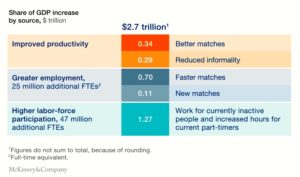
Unemployment fell to a 20 year low in Q4 of 2017, now standing at 4.1. A tight labor market will increase competition and opportunity for employees with specialized “in demand” skill sets. Talent now has leverage; however certain items may slow this revolution in the workplace.
Healthcare coverage is the primary one, retooling and training of inactive workers being the other. Look for these talent platforms and AI to play a role in resolving those challenges in the future. Additionally, changes to regulatory frameworks, corporate practices, and individual mindsets, may be required according to McKinsey’s research.
One thing is certain, the forces behind this transformation are accelerating driven by the recent tax changes. Apple and Amazon have announced they will be creating tens of thousands of jobs in the US. Added that amount of new positions to an already tight labor will force us to think about how work is done, and who does it. The jobs may be here but where the “work” gets done may not. We may not only see the “death” of the company “employee” but also the concept of a “domestic” workforce.
For more articles and insights like this delivered straight to your inbox, sign up here!


