by scott.gillum | Jul 27, 2016 | 2016, Marketing
A few weeks ago, I participated in an interview with CEB‘s new Marketing Solutions group. The focus of the article, as they described it, was to “understand what it takes to have a healthy client-agency relationship.”
The article was published in their July monthly newsletter to members. CEB was kind enough to allow me to share an excerpt of the article with my readers (see below).
We asked agency leaders from key partners in CEB’s recently launched Marketing Solutions* effort to answer the question “What key relationship-building steps do clients most often overlook?” Below you’ll find our curated list of top overlooked steps:
- Make Sure They “Get It”: No matter how well the agency knows your industry, there needs to be discipline on both sides, ensuring the agency invests time getting to know your business, customers, brand, and the expectations of key stakeholders.
- Keep the Creative Spark Alive: Saying “no” too many times or being too directive can kill a client/agency relationship. You’re looking for a fresh perspective, not a passive, tactical partner. Challenge your agency to do at least one wildly strategic or creative thing for you each year, something that might even make you a bit nervous.
- Be Constructive: Creative teams invest time in understanding a clients’ issues/objective and then brainstorm on possible solutions. Keep in mind that it’s not what you say, because agencies need your input, it’s how you say it. First be complimentary, what you like, and then give notes.
- Don’t Miss the Magic: Too often RFP’s are focused only on qualifications and price. The real magic in an agency relationship is how well you work together. Be mindful of the way your teams will work together—and bring out the best in each other—that will really make a difference.
- Understand Limitations: A good creative campaign can change perceptions about your brand, products, and even service capabilities. However, it is the burden of the organization to deliver on the “promise” being communicated. Be realistic of what your agency partners can and cannot solve for.
- Agency’s Ability to Help You Bust Internal Silos: Assess agency candidates for their understanding of key partner functions (like sales, service or operations) and their ability to help you bring those other partners into creating seamless customer experiences.
- Agency’s Ability to Disrupt Your Customers: Winning marketing efforts disrupt what customers think, believe, and assume about themselves (not about you). Bottom line: pressure test your agency’s empathy—the ability to go deep into how customers think about themselves and their own world.
Additionally. CEB is now providing execution support on B2B go-to-market messaging and content creation. They’ve partnered with select agencies, like gyro, to offer engagements that help create messaging and content that reflect the latest insights from CEB’s B2B buyer and best practice research If you’re interested in learning more, send me a note.
by scott.gillum | Jun 16, 2016 | 2016, Sales
I’m a “binger.” I’m “all in” when it comes to consuming content and I’m not alone. Netflix reports that of it’s 40 million US subscribers, over 60% report being “binge watchers.” We also know that our personal habits influence our professional habits, so could there be a group of “binge buyers” who are currently being underserved with our content efforts, and could that be hurting our sales efforts?

For example, I’m working with a client to help them “digitalize” the organization. As part of the effort, I’m evaluating software tools to help improve the performance of their content marketing efforts. So I’ve been binging on vendor content, going deep into their sites and watching hours of video to evaluate their fit for our client’s needs. However, one of the vendor’s limited the information on their site forcing me to request a demo to learn more about their tool.
Ten days after I requested the demo the vendor finally reached out to me. It then took another 3 days to align our schedules. The day of the “demo” was disappointing. I didn’t get to see the tool, but instead I got a 10 page powerpoint pitch. Running out of time that day forced me to set up yet another call more than a week away. Needless to say, they didn’t make the short list of vendors to consider.
Here’s the point we know from CEB, Sirius Decision, and Forrester decision makers are more than half the way through the buying process before they engage a sales person. If you are an organization that is trying to insert a sales person in upstream, you run the risk of slowing the buying process and/or being eliminated from it.Your prospects maybe “bingers” like me. Let them go deep and gather all of the information they need on their own. It will accelerate your sales cycles, increase lead volume, and lower the cost to sell. I know it will set off alarms with your lead tracking process, but the fact is, buyers control the process and they will let you know when they need to talk to someone.
Still skeptical? Atlassian, an open source provider of project management and app software sold over $300 million in enterprise software without a single sales person. The keys to their success: a great product, word of mouth and letting buyers sell themselves. “Customers don’t want to call a salesperson if they don’t have to,” says Scott Farquhar, Atlassian’s co-chief executive officer.
“They much rather be able to find the answers on the website.”
Don’t get me wrong. I believe sales people can serve a very valuable role for the buyer, and for organizations. But that role has shifted, instead of being the product “spokes person” they should now focus on better understanding what information buyers need to drive a consensus on a decision within their organization.
Unsatisfied with my first call with the rep that left me without seeing the tool, I found a product demo video on Vimeo. I doubt they even knew it existed, so by second call, I was already well versed on the tool. I knew how it differed from the other tools being evaluated, but what I didn’t know was why my client would need that functionality. That is where the sales person could have been helpful, and could of earned themselves a shot at the sale. The lesson; bingers are out there and growing, if you throttle bandwidth on content you could be limiting, or in this case, eliminating opportunity.
by scott.gillum | Oct 29, 2015 | 2015, Sales
My first job out of college was selling office equipment. The first thing I ever learned about selling (from my very Southern sales manger) was that “Telling ain’t selling.” In layman terms, stop telling customers why they need your product and start listening to their needs.
For years this simple phase remained in my memory. It guided me as a way to engage prospects in advisory-like sales dialogue, probing for a need to sell to. But, after attending CEB’s Sales & Marketing Summit last week, where new research highlighted the increased complexity in reaching a purchase decision, I’m now considering rethinking my whole approach.
Why? Because buyers have become overwhelmed by the potential choices, 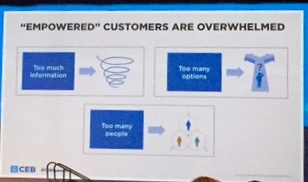 and the involvement of other decision makers in the process, according to Brent Adamson, co-author of The Challenger Customer. Too much information, too many options and too many people involved in the process are making it more difficult than ever to reach a consensus, let alone a purchase decision. Given the complexity, stalled deals are no longer a sales issue; they’re a buying problem.
The question is: Are marketers contributing to that problem? Is it possible our content marketing efforts, aimed at helping buyers make an informed choice, are becoming part of the “too much” problem? According to Psychologist Barry Schwartz, author of The Paradox of Choice, too much choice often results in no choice at all.
Dr. Schwartz’s research has shown that limiting choice is often necessary to reach a decision, and/or to speed up the buying process. As he said, “When you make choice easier, or more simple, you will sell more.”
For business-to-business sales and marketers, the key is to become “prescriptive,” according to Adamson. Customers need a “trusted advisor” to help guide them through the complexity of the decision making process, in particular in driving a consistent point of view on the problem, and the best solution. Schwartz suggests focusing on the following three areas:
- Be the “expert” or “simplifier.” Help reduce the complexity of the problem, process and/or solution. Smart content should help to explain and simplify solutions to complex problems.
- Create an “anchor.” Help customers understand how to assess the value you offer. Buyers may have a hard time assessing the true value of a new purchase or a new vendor. Help them by giving them context. Find a relatable anchor comparison. Think: ”Platinum service at a standard price.”
- Understand the impact of “no decision.” If no decision is the right decision, then find a way to make it the default answer. This approach is commonly seen in software or subscription-based services where membership/licensing automatically renews.
Do we now dictate to customers/prospects? Not according to Schwartz. Asking probing questions that lead customers to convince themselves that they need your product is the path to goal attainment. Help them understand how your product/service uniquely solves their problem by guiding their path to purchase.
The words of wisdom given to me years ago were right, but given today’s increased complexity it needs an updated “Telling ain’t selling…until it is.”
by scott.gillum | Sep 3, 2015 | 2015, Marketing
Just when we’ve convinced the organization that the key to our marketing communication success is personalized content, new research from CEB highlights that we actually may be doing more harm than good.
The years spent improving our understanding of the buyers journey, the development of more insightful personas and content, may have resulted in marketers ability to be too good at personalizing solutions to buyers. How can that be?
 The issue, according to CEB’s research underpinning their new book The Challenger Customer, is that our improved ability to increase a buyer’s awareness of those areas of a solution most relevant to them, has inadvertently increased visibility into the overall risks associated with the purchase decision and/or change. As a result, buyers begin to unbundle and simplify solutions, driving down price points. The shocker of this insight is that marketers improved ability to personalize content may be coming at a cost to sales.
According to co-author, Pat Spenner, the real challenge lies in convincing buyers to first agree on making a change. “Focus your content marketing efforts on creating a consensus case for change among the decision making group,” which according to CEB’s research, now involves at least five people in the typical B2B purchase.
According to Spenner, “personalization can hurt the buyer’s ability to get that critical early consensus, because it can cement those individual stakeholders into their individual contexts, without doing anything to bring that more diverse group together around a common vision for change.”
So should we stop personalizing our communication? No, but it does highlight the need to also create that common rallying point, and to equip key buying group stakeholders with the tools to create consensus around it. Something the authors say helps clients elevate the conversation from “me to we,” an umbrella approach that ties your content efforts together regardless of the audience being targeted.
To motivate buyers to change you first have to disrupt their status quo by planting and nourishing seeds of doubt about “business as usual.” Show them not just the benefits of action, but the consequences of inaction. CEB recommends using fact-based content built off a Commercial Insight to break down buyers existing mental models.
Concurrent with breaking down the audience’s long held beliefs, you need to give them something to aspire to — a new future state that rallies the group to take action. This is where a compelling creative campaign does the heavy lifting. A “big play” campaign, like IBM’s “Smarter Planet” creates a compelling future vision but also provides a broad platform to disrupt IBM’s many different buyers and to cover IBM’s expansive solution/product portfolio.
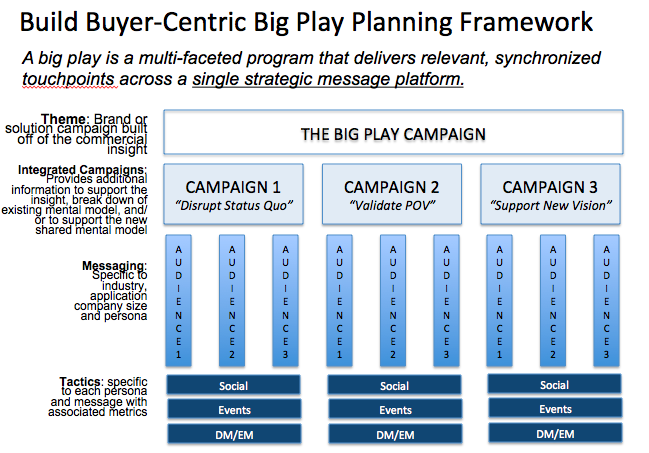
Personalization is still essential, and comes via messaging to specific audiences, but it is built on the commercial insight, and aligned to the common vision of the future state. It’s not that personalization doesn’t work, in fact, it can be very effective for breaking the status quo,” according to Spenner, “but you also need an unifying rallying point for buyers who may be too attuned to the risk associated with change.”
The key to leveraging the good work marketers have done to increase relevancy with buyers? Properly balance and/or convince the audiences that the rewards associated with making the change, both organizationally and personally, outweigh the risks you’re asking them to take on. If not, they will reduce the risk for you, and you may be hearing about it from sales.
by scott.gillum | Mar 2, 2015 | 2015, Marketing
For business, this is turning out to be the “year of the human.” Andy Goldberg, global creative director at GE, said in an interview with Advertising Age about marketing trends in 2015: “We need B-to-B to be more human.” Karen Walkers, SVP of marketing at Cisco, went ever further by saying, “Devotion to brands begins and ends with an emotional connection. Buyers are people, people are humans and humans are emotional beings.”
Why this sudden awakening of humanity in tech marketing? The recognition that business decision makers are also people with emotional needs? Well, the answer might surprise you, and it’s based on a good bit of data and research.
The CEB (formerly Corporate Executive Board) first picked up on this trend in their research that found communicating business value (functional benefits of a product or service) was not differentiating because perceptions on that value h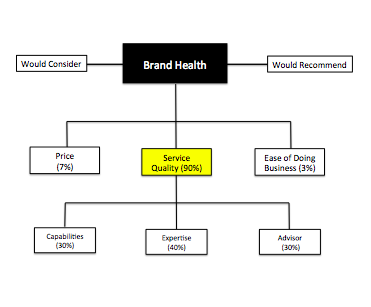 ardly varied between brands.
For example, a recent brand health study for a tech client found that 90 percent of their brand health (defined by a willingness to recommend and consider) was driven by service quality. Service quality made up 90 percent of the attributes in the graphic.
The smart marketer would think that in order to improve our brand health, we should increase our focus and communication for the performance attributes related to service quality. And they would be right, except for the fact that those business value drivers also apply to all competitors in the category, which is apparent in the graphic below:
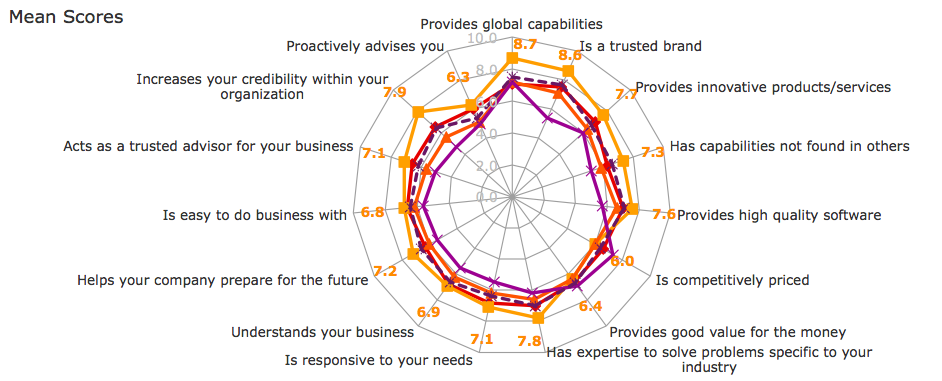
Each color line represents how a competitor scored on performance attributes under capabilities, expertise and strategic advisors. It is almost impossible to distinguish between the five companies represented (except for the competitor in orange, which also happens to have a leading share of market, mind and voice).
What is clear from the research is that rational purchase drivers that communicate business value, although important, are nothing more than “table stakes.” So what creates separation?
The answer: An organization’s ability to build and communicate value based on the understanding of the risk/reward dynamic involved with a purchase decision. The reason: There is a direct correlation between the level of risk and the emotional involvement of the buyer. The higher the risk, the more emotions play a role. Technology purchases are a particularly high risk because they support critical functions within an organization from payroll to customer communications and more.
As a result, personas need to go deeper into understanding the emotional state of buyers as they go through the buying process. Marketers should map the mental state before, during and after the purchase decision, noting the emotions that buyers might be feeling at that time. Here are some key questions to consider as you go through this process:
- What challenge(s) does this purchase decision present for the buyer? It will defer if the buyer is new versus existing. As a marketer, it’s crucial to know how it’s different.
- What personal risks are at stake for this decision maker? Could they lose their job if they make the wrong decision? Invest in understanding their role and their challenges.
- What are the personal rewards for the buyer? Consider how the decision will pay off for them personally. Most often this will be career oriented, but not always.
It’s also important to note that buyers will already have preconceived feelings towards your brand. This may be a benefit or another hurdle to overcome. Our research in partnership with the FORTUNE Knowledge Group found that nearly two thirds of C-level executives said they believe subjective factors that can’t be quantified (including company culture and corporate values) increasingly make a difference when evaluating competing proposals. Only 16 percent disagree. Furthermore, 70 percent believe that a company’s reputation is the most influential factor when deciding what company to do business with.
Buyers trust their gut to make the right decision based on how they feel about a product and/or brand more than we think (and definitely more than we communicate). They make purchase decisions based on emotions, and then justify them with the business value drivers. It’s the emotional connection that triggers the decision and feature/functionality to support it, not the other way around.
What company does this best? It’s Cisco. Research has shown that they are the most emotionally connected customers. Not surprisingly, as Karen Walkers points out, Cisco recognizes that buyers are not just decision makers with budgets, but rather people who are emotional beings.


