by scott.gillum | Jun 16, 2016 | 2016, Sales
I’m a “binger.” I’m “all in” when it comes to consuming content and I’m not alone. Netflix reports that of it’s 40 million US subscribers, over 60% report being “binge watchers.” We also know that our personal habits influence our professional habits, so could there be a group of “binge buyers” who are currently being underserved with our content efforts, and could that be hurting our sales efforts?

For example, I’m working with a client to help them “digitalize” the organization. As part of the effort, I’m evaluating software tools to help improve the performance of their content marketing efforts. So I’ve been binging on vendor content, going deep into their sites and watching hours of video to evaluate their fit for our client’s needs. However, one of the vendor’s limited the information on their site forcing me to request a demo to learn more about their tool.
Ten days after I requested the demo the vendor finally reached out to me. It then took another 3 days to align our schedules. The day of the “demo” was disappointing. I didn’t get to see the tool, but instead I got a 10 page powerpoint pitch. Running out of time that day forced me to set up yet another call more than a week away. Needless to say, they didn’t make the short list of vendors to consider.
Here’s the point we know from CEB, Sirius Decision, and Forrester decision makers are more than half the way through the buying process before they engage a sales person. If you are an organization that is trying to insert a sales person in upstream, you run the risk of slowing the buying process and/or being eliminated from it.Your prospects maybe “bingers” like me. Let them go deep and gather all of the information they need on their own. It will accelerate your sales cycles, increase lead volume, and lower the cost to sell. I know it will set off alarms with your lead tracking process, but the fact is, buyers control the process and they will let you know when they need to talk to someone.
Still skeptical? Atlassian, an open source provider of project management and app software sold over $300 million in enterprise software without a single sales person. The keys to their success: a great product, word of mouth and letting buyers sell themselves. “Customers don’t want to call a salesperson if they don’t have to,” says Scott Farquhar, Atlassian’s co-chief executive officer.
“They much rather be able to find the answers on the website.”
Don’t get me wrong. I believe sales people can serve a very valuable role for the buyer, and for organizations. But that role has shifted, instead of being the product “spokes person” they should now focus on better understanding what information buyers need to drive a consensus on a decision within their organization.
Unsatisfied with my first call with the rep that left me without seeing the tool, I found a product demo video on Vimeo. I doubt they even knew it existed, so by second call, I was already well versed on the tool. I knew how it differed from the other tools being evaluated, but what I didn’t know was why my client would need that functionality. That is where the sales person could have been helpful, and could of earned themselves a shot at the sale. The lesson; bingers are out there and growing, if you throttle bandwidth on content you could be limiting, or in this case, eliminating opportunity.
by scott.gillum | Feb 28, 2016 | 2016, Marketing
 Having a hard time convincing “the powers that be” to invest in the brand? Ever wonder why it’s so hard, why all they want from marketing is leads? Let me explain.
In organically grown companies, an organization develops a product or service and goes to market through a sale channel, either owned or via a partner. At this point, the organization is focused on acquiring customers and generating revenue. With low market awareness the organization typically has more sales capacity than demand for its products or services.
If marketing exists, it’s in its infancy, and plays a tactical role developing sales material, supporting business development activities, and it may have a small social media presence.
To fuel the company’s growth, the management team begins to realize in order to make sales and revenue objectives it has to be able to create demand beyond what the sales channels can generate on its own. As a result, marketing expands beyond its most basic sales enablement role into being responsible for generating leads.
When growth slows and/or begins to plateau, the executive management team will (or should) begin to explore the value of “strategic” marketing. Unfortunately, these strategic marketing activities and investments aimed at broadening awareness of the brand are often misunderstood and/or dismissed all together. Here’s why they shouldn’t be, and why they are critical to unlocking a company’s next phase of growth.
Why it’s so hard getting to “Yes”
The challenge in convincing the organization that marketing can be a strategic growth level is one of perception. Because marketing evolves “bottom up” as I just described, the common perception among executives is that marketing is a “tactical support” function.
The second issue is the messenger. The staffing needs of marketing in its infancy are simple, and usually satisfied by an entry-level hire or someone without a marketing background. Rarely, will this person rise to a senior management level. Achieving senior executive “gravitas” is critical for changing perception among the senior management team, especially if the company has a strong sales and/or product culture.
How to win the battle
To convince executives, you have to tie brand investments back to something “tangible.” Your argument has to show a direct connection to an organizations performance, be it sales, profit or the customer. And, if you can improve your message, you will also improve how your executives view the messenger. Here are three areas to explore.
- A strong/valued brand lifts price point. Are reps constantly complaining about being beaten up on regarding cost/price? A company that has a strong brand can command a price premium. Years ago, I did some work with competitor of Cisco and found that the Cisco brand had a price premium of 7% over the competitors. Why? B2B purchases are high risk, and as a result, are emotionally charged. Buyers that connect personally to brands are willing to pay more for their product if they believe it will reduce the risk of a bad decision. Need proof, click here.
- Improving top of the funnel performance improves the performance of the entire pipeline. Need to increase leads? You have two choices, expand the top of the funnel, or increase conversation rates. The best solution is to do both. By expanding the number of prospects aware of your product you increase the number who will also consider it, which increases the number of opportunities, leads and wins. If you only focus on increasing leads, you’re stuck with improving conversion rates, which may be much more difficult and/or costly.
- Brand building doesn’t mean you need a big budget. The fact is you’re doing it everyday, for better or worse. Every conversation a sales rep has with a prospect creates a brand impression, every unresolved service call to the contact center has the potential to damage the brand. You can make great strides by clearly and consistently communicating what the brand stands for both internally and externally. Once defined, put it into the language of your audience in the simplest terms possible. Complex, “consultant like” words and terms are meaningless. The really smart folks simplify the complex.
Now that you’ve made the argument, it’s time to close the deal. When an executive evaluates a proposal from your company against other competitors, do you know what tips the scale in your favor? No, it’s not price, or the “relationship,” it’s your reputation, your brand. It’s how they feel about your company…and that’s not in your proposal.
by scott.gillum | Jan 19, 2016 | 2016, Marketing
 Go ahead and get mad at me. Feel free to fill up the comment section below. I’m going to share our closely held secrets with sales people, skeptics and other critics of marketing. I know you would rather I not, but it’s best for all of us, trust me. Here we go…
#1 – You got lucky – if you generate leads off the first drop/wave of a new account acquisition or a lead generation campaign for a solution, you’re more likely to be lucky, than right. Yea, you may have had a compelling offer, and the call to action was intriguing, but the chances are, you just happened to hit a prospect at the right time.
Sure, in some industries you can buy data that identifies a company’s spend on certain products or services. But you don’t know if the budget is available, what portion of it, or who controls it. And since this is a prospect, you are most likely targeting a title, which could be a decision maker, a budget holder, or just a curious information seeker.
At the beginning of a campaign you simply don’t have the information on a prospect to know where they are, or how to advance them in the buying process. So, if a prospect does put their hand up and says, “Call me,” you most likely hit them at the right time in the buyers’ journey.
#2 – Your messaging is weak – the effectiveness of your message is being compromised by the fact that you are trying to motivate an audience to think or feel differently without explaining why. According to Pat Spenner, co-author of the new book entitled The Challenger Customer, marketers spend too much time focusing on how they want audiences to think, or feel, without understanding their current mindset.
Research for the book found that the receptiveness and/or openness to a message depends heavily on an audience’s existing belief system, which drives their behavior. According to Spenner, marketers first need to understand and break down the audience’s current mindset using insights about their business, customers, markets, etc. It’s an opportunity to “teach” audiences that their current thinking is no longer valid and why a new way of thinking is needed. If done well, the new mindset will uniquely lead them back to your product/services or brand.
For example, Merck developed the cholesterol-lowering drug Mevacor at a time when doctors knew little about the effects of cholesterol on the body. The current mindset was that hypertension (high blood pressure) caused heart disease. Merck used clinical research to show doctors the impact of high levels of cholesterol on arteries and the correlation of plaque buildup with coronary heart disease (the “teaching” moment).
As a result, doctors should test patient’s cholesterol levels to see if they are at risk. If a patient had a LDL cholesterol level above a certain point, doctors should start with a therapy regiment that included diet and drug treatment (the new mindset). The only cholesterol-lowering agent available at the time was, you guessed it, Mevacor. Merck, by getting doctors to change their mindset about the causes of heart disease, lead them back to their product. As Spenner puts it, effective story telling for marketers should “lead to, not with.”
#3 – You’re doing lead nurturing the wrong way – changing mindsets takes time. Yes, you’ve built prospect profiles, aligned content to their interest, and you may even know how to engage them in their preferred communication channel. The problem may not be your content marketing efforts but the fact that prospects are stuck in the status quo. They may find your information interesting, but it hasn’t convinced or motivated them to change their behavior.
Nurturing efforts should continue to break down, or build up, the new mindset across the buying group. The ability to drive specific information aligned to individual buyer’s needs may actually be causing more dysfunction within an already dysfunctional group. To advance a prospect/s refocus efforts on driving consensus on the issue and solution within the buying group. If done correctly, like Merck, prospects will come to own conclusions that you offer the best solution for their needs.
Motivating an audience to change doesn’t happen overnight. Unfortunately, marketers are under constant pressure to perform and rarely have the luxury of time to change their approach. It’s the reason I shared the first dirty secret, to buy marketers time to create the type of campaigns that deliver insights told as a story revealed over time.
The first wave of your campaign will generate leads, but it’s the waves that come after that really count. If marketers can stop telling customers why they need their product and let them come to that conclusion on their own, response and conversion rates will double based on my experience. But don’t tell anyone, it’s a secret.
by scott.gillum | May 11, 2015 | 2015, Marketing
Look at the tweet, then read the graphic. Why is the headline on this tweet by Spencer Stuart, “Majority of marketing leaders want to see data-and analysis driven decision marketing on their teams,” and not “Majority of marketing leaders want to see more creative thinking and exploration on their teams?”
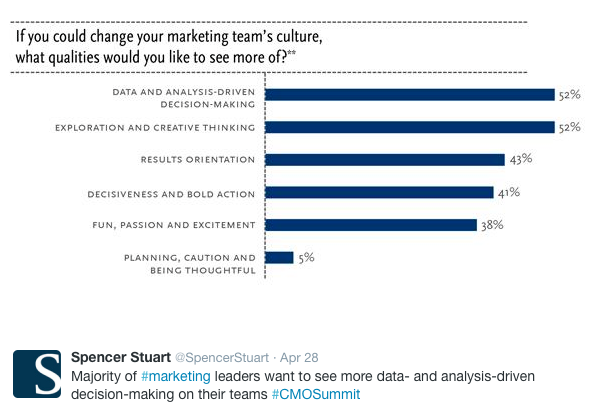
Statistically they’re the same, yet Spencer Stuart emphasized the data/analytic decision making why? “Combine Fun, Passion and Excitement” with “Decision and Bold Action” and you have a solid argument for changing the marketing team’s culture to “Exploration and Creative Thinking.”
On the flip side, only 5% of marketing wants a culture of “Planning, Caution and Being Thoughtful,” amen brother. Ok, I hear you, “if it was “fun” they would call it “play” not work, but maybe we need a little more play at work.
According to Peter Gray, a professor at Boston College and author of Free to Learn, ”play” can be the key that unlocks the mindset of bold creative thinking. In an article on Psychology Today, Gray says that the “alert but unstressed condition” of a playful mind has been shown repeatedly, in psychological experiments, to be ideal for creativity and learning new skills.
“Experiments have shown that strong pressure to perform well (which induces a non-playful state) improves performance on tasks that are mentally easy or habitual for the person, but worsens performance on tasks that require creativity, or conscious decision making, or the learning of new skills.” Although accountants may perform well under pressure, it could be a creativity killer for marketers.
One could conclude then, if an organization too narrowly focuses on “analysis and data driven decision making,” it may come at the expense of “Exploration and Creative Thinking” mentioned in the research and Tweet. Said differently, all work and no play, could make your marketers dull.
Pressure to perform in business marketing is a given, so how do you strike a healthy balance? Stephanie Anderson, CMO of Time Warner Cable’s business division, suggested that by ” focusing on business results first, ensuring that you have a way to show the business impact of marketing activities, you’ll have the foundation in place in order to inject a fun and creativity into the workplace.”
by scott.gillum | Jan 12, 2015 | 2015, Marketing
Just in time for the cold and flu season, scientists have recently discovered that the “Pareto principle – the 80/20 rule” applies to infectious diseases. “Super Carriers” who represent 20% of the population, are responsible for transmitting 80% of infectious diseases.
 Superspreaders, like “Typhoid Mary” of the 1900’s, have the ability, although not fully understood, to infect others without falling ill themselves. Come in contact with the one of them, live in a densely populate area, and you’ve got the recipe for a massive outbreak.
Like viruses, information is spread in similar ways. The importance of “links per node” in social network influence has been studied for years. Research has shown that it’s not the number of links, but rather how “strategically placed” people are in the core of the network, that leads to dissemination of information or disease through a large fraction of the population.
“Typhoid Mary” for example, was a cook in New York City and had an opportunity to infect large groups of patrons with typhoid fever breakfast, lunch and dinner. Readers of The Hot Zone, or Dan Brown’s Inferno, will also be familiar with the concept of geometric progression’s role in the spreading of disease.
Applying these same principals to the distribution of information yields some important insights for content marketers. Given the nuclear arms race going on in content creation and distribution, finding a way to get your message to, and consumed, by targeted audiences is becoming mission critical.
Superspreaders are a perfect route, and represent an opportunity to narrow your message. Think about it this way instead of trying engage 80-100% of your target audience (being everything to everyone) which is a sure fire way to get lost in the noise, you need only to appeal to the right 20%.
How do you find them? It begins with the mind shift of moving from quantity of contacts, to the quality of those contacts…their place in the network. If your organization is set on measuring social media by the number of fans, followers, etc. you’ve got your work cut out.
Find and profile the key influencers in your industry, and/or on a particular subject matter, and don’t solely rely on social media…you’ll end up with “false gods.” Ask the sales force, monitor speakers on industry events, search for authors on the topic, and scan the academic horizon. Once you’ve created your list, study their language.
Now, use your PR and social monitoring tools, as well as other sources, to understand how and what they communicate. Narrow in on those influencers who are in the right position to distribute your content to the right audience, and not those who may have the most followers and/or may be the most active. “Right position” may be related to position to audience, but it may also include, adding validity to your information.
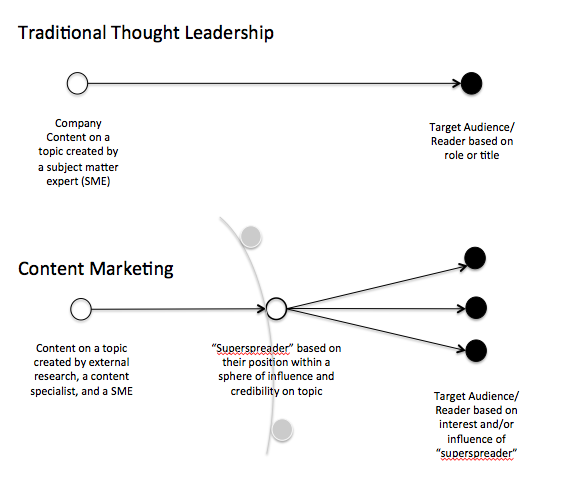
In the digital world, the credibility of the content source is as important, if not more important than, as the actual author/content producer. In the past, companies aimed thought leadership campaigns directly at audience on topics they wanted to communicate. Success with content marketing depends on targeting key influencers with topics that resonate with them in their language so they will pass the information on to their followers.
As a result, you may want to score social spreaders (not a Klout score, use your own ranking) based on their influence (position + credibility). Set a goal for the year to get their attention through a mention or a share, just as you might do with targeted media. Tell your story by designing a content strategy based on the topic areas, language, and the interests of your superspreaders. Then let your “Typhoid Mary or Larry” spread your information…it’s called viral marketing for a reason!


