“Who invited marketing to the sales pitch?” It was said in passing, and intended as a joke, but the marketing team got the point.
The comment was made in a recent messaging workshop. The head of sales expressed his frustration at the messaging being developed by marketing. His point — there was nothing different. It sounded like the same sales pitch they had been giving customers for years.
He was right, and it got worse. Marketers were sending the message to the same audience, creating even more reason for buyers to tune them out. Good marketing, as we all know, should help open doors for reps, not close them in their faces, which is what was happening.
The Situation
The company was in the ingredient business. Similar to an OEM, their ingredient went into a part that was a component of a product bought by customers. Their additive had been on the market for 10 years and as an “ingredient” had few unique selling features. Its value was defined by how it was used further down the value chain. Keep this in mind while as you continue reading.
As a regulated additive, sales reps spend much of their time helping parts manufacturers understand how, and when, to use the ingredient. Despite this knowledge, parts manufacturers were reluctant to increase its use…growing share in existing customers was difficult and converting new buyers to use it was challenging. They had “pigeon-holed” the ingredient for only certain uses.
Unlocking Value to Create Demand
Making things even more difficult, the company relied on the part manufacturer to convince the product maker to add their ingredient. The reality was, the part maker only used the ingredient when it was required by the product manufacturer. In other words, the part maker was taken orders from the product company and building to specific requirements. Once that was defined no amount of sales or marketing was going to change that fact.
This reality became the tipping point for turning our interest to the product maker and the end customer. The “ah-ha moment” struck on day two when, using the Challenger Marketing approach, the team discovered that end customers were not aware of a potential risk that could impact their business, as much, or more, than the risk they were currently addressing.
Messaging the “Value” to the Value Chain
By getting into the heads of the end customer we were able to determine that their existing mindset exposed their business to a much bigger risk than what they realized. Using secondary research, the team put together a compelling data backed story that was built on insight (the unknown risk). That insight would then be messaged in different ways depending on where the story was being told in the value chain.
For the end customer, the story and message highlighted the value of protecting their customers and employees. The product manufacturer message to customers emphasized (with research and data) the risks and the potential business impact of inaction. The parts manufacturers received a message about the potential opportunity to double their business based on the new use of the product at the customer location.
Shifting from “Push” to “Push and Pull”
The biggest impact was the organization shifting its strategy from “pushing” their product through the part manufacturer to creating “pull” from the demand side. Marketing shifted its research efforts to the end customer to build a “use case” highlighting how to address the formerally unknown risk. Sales, backed with a solid business case of how to double revenue, realigned its focus from the part maker to the product manufacturer.
How to Apply this Approach to Your Organization
Schedule a two-day working session with representatives from sales, marketing, and the product group.
Prep everyone to leave their “company hat” at the door. The session is intended to have you think like the end customer. (e.g. How they think about their business, customers, competitors…not your product, service or brand).
Map in detail the go-to-market model.
List the reasons why the end customer buys the product or service. What “job does it do” for their business. This will require some research about the customer’s business. Do this in the session or have it ready ahead of time. Try to understand the customers mindset. This isn’t about why they should buy it from your partner or organization.
List the reasons why resellers or distributors buy the product from your organization (assuming you’re the manufacturer), and so forth back through the chain. Be brutally honest, for example, if it’s because it’s the “cheapest” then call it out.
Define the value added in the GTM model at each step starting with the customer working back from right to left in the model. Typically this is done from left to right.
Ask what are buyers missing at each step in the value chain? What should they know but don’t? This is the opportunity to develop a new insight and messaging.
Unlocking good insight isn’t easy. Coming out of the meeting you will have to continue to refine it. If you haven’t asked, and answered, “so what” at least five times you haven’t gotten to the core. If that doesn’t work, give me a call.
Like this blog? Never miss another update again by joining our email list here!
It was in high school or college…probably a standardized test. The one you just looked at and immediately knew you were in trouble.
A three sentence word problem with statistics. The tension was palpable and you read it, again and again.
Nothing. No recall whatsoever. Your mind was blank as if you’d overloaded every synapse available.
Well, in fact, you had. It’s called cognitive overload and there is a chance your marketing may be causing this same effect.
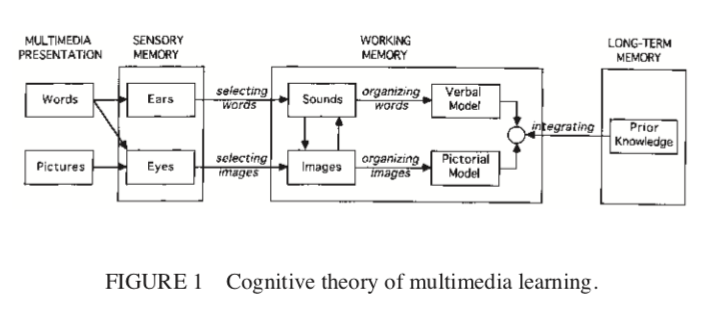
Cognitive Load builds upon the widely accepted model of human information processing, first published by Richard Atkinson and Richard Shiffrin in 1968. It describes the process as having three main parts:
1) sensory memory
2) working memory
3) long-term memory
Sensory memory (ears and eyes), along with long-term memory, have an unlimited capacity to take in and store information. Unfortunately, working memory (how we interpret, deconstruct, and process words and images) doesn’t.
Educational psychologist John Sweller advanced this thinking with his Cognitive Load Theory. This pivotal research revealed how the mind processes information (dual channel – verbal and visual) and the best methods for communicating complex concepts.
For marketers, the key insight is that the mind has limited cognitive processing capacity, both visually and contextually.
Dual channel – humans possess separate information processing channels for verbal and visual material.
Limited capacity – there is only a limited amount of processing capacity available in the verbal and visual channels
Active processing – learning requires substantial cognitive processing in the verbal and visual channels.
Mayer and Moreno then tested their assumptions against the three main parts of memory mentioned above; sensory memory, working memory, and long-term memory. Here’s what they discovered:
The mind does several things when overloaded, and none of them are good for marketers.
The first thing the overloaded mind does is to bail, quickly determining whether it’s worth the effort to turn on active processing.
Next, if the mind decides to give it a go, it then looks for the easy route — association. The mind taps into long-term memory and says, “This looks like a lot of work; have I heard or seen this before? If so, then this must be the same thing.”
Lastly, the mind fully engages, but in doing so uses so much processing capacity that there is nothing left over to move the elements of the engagement into long term memory.
The impact for marketers is one or more of the following:
1) your message is ignored,
2) it’s non-differentiate (because sounds or looks like something the audience has already seen or read),
3) the message is received but audiences are not motivated to take action,
4) the message is received, and then it’s completely forgotten,
You just ran the table of wasted effort, thanks to cognitive overload.
Now, let’s apply these lessons to our marketing efforts and identify both danger zones and potential solutions.
Content – Like to use internal speak, long or complex words, tech-jargon and/or acronyms?
Good luck. You’re playing around with what’s called “split-attention effect”, overloading one channel with too much information. It can lead to your message being misinterpreting or missed altogether.
There’s a simple fix: Use a tool like a Gunning Fog index to test your content for readability, break the content up into smaller pieces, balance visual and contextual elements. A picture is really worth 1000 words, at least to the mind.
Video – Using subtitles in your videos? Using text to explain what the taking head is saying? Laying text onto a visual?.
You’re overtaxing the visual channel. Remove the text and add it to the voice-over. Creating 10 minute or longer explainer videos? Cut them into a series of 5 two-minute videos if you want the audience to recall the information.
Digital and direct mail – Like to give the audience lots of options, or crowd a page with offers (like the ad below), and multiple messages? Mistake.
More is not better.
More is overwhelming and you’re headed to cognitive overload-town.
A couple of tools can help fix this issue.
Electroencephalography (EEG) is a brain imaging method that assesses the intensity of engagement and whether audiences exhibit positive or negative emotional responses to a stimulus.
If that’s too complicated, here’s an easy one, Eye tracking tests measure the gaze and movement of the eyes. This information can help understand how an audience’s attention is being captured or diverted by particular experiences or stimuli.
How far have we really come since the Cluetrain Manifesto? It’s sad to admit, but arguably true, that much B2B marketing still flirts with mediocrity. Why? Part of what contributes to the mediocrity is the tendency of B2B marketers to race towards “best practices,” seeking, paradoxically, to achieve brand differentiation by imitating the past practices of competitors and predecessors.
In marketing strategy, the perceived safety of doing what others have done is an illusion. “Best practices” are properly reserved for simple situations that can be dealt with according to simple categorical logic. Branding problems can rarely be reduced to such simplicity without overlooking dimensions of the situation. Sometimes those dimensions are critical factors in success or failure.
Once we acknowledge that “strategy by imitation of practices” has a poor prognosis, it’s a short step from there to go looking for a theoretical foundation for action.
Our theoretical foundation takes the form of a “dissenting opinion” towards a handful of (largely unexamined) theories that are implicit in practices and advice widely found in the B2B marketing space. At Carbon, we exploit this contrast as an engine of strategic differentiation for our clients. Here are 5 components of that engine:
1) People have a deep and profound need as social animals to belong to groups, to achieve and maintain status within groups, and to construct and signal identity in the context of these groups.
Few people would disagree, but just the same, this point of view on motivation is still mostly ignored in B2B marketing and sales strategies that emphasize rational business benefits. As deals get bigger, and buying committees get larger, the error of underestimating this factor in motivation becomes more regrettable.
2) Most of the time the human mind is operating in a state characterized by a fast, non-deductive, association-driven path.
This view, deried from behavioral economics, stands directly opposed to the classical economic imagination of people as “rational actors.” Something at stake in this dispute is our understanding of how we best achieve desired meanings in the mind of our customer. Should we focus on telling people what we’d like them to believe, or should we design a coherent fabric of associations and invite people to participate in constructing meaning from it? Most zig, we zag.
3) B2B buying is a group decision, and group decisions are chaotic and non-linear. On good days they resemble the pursuit of design problems. On bad days they resemble a garbage can.
This take on decision theory (and thus buying) stands in contrast to the (usually unexamined) assumption that business decisions are pursued in a logical process that begins with a stable set of identities, goals preferences, and advances in a straight line towards the optimization of outcomes. This assumption is perfectly aligned with the metaphors of “funnel” and “buying journey.” Just not with reality.
4) Experiences are meaning-making opportunities. Stimulus and response are separated by a meaning-making operation.
This stance is opposed to the mechanistic behaviorism that lurks beneath notions like “monetizing eyeballs,” “unique selling propositions” and “the b2b content factory.” Notions like these come and go, but the underlying assumption, for all its flaws, seems hard to kill.
5) Firmographics and role titles are more useful for counting potential customers than they are for building strategies that move those customers to action.
This stance contrasts the segmentation assumptions of most B2B marketing and sales organizations. We see that as limiting in two ways – first, it’s non-differentiating since firmographics and role titles are no mystery to competitors. And second this knowledge is not as helpful as people generally imagine in persuading prospective customers to adopt a belief or a behavior.
We don’t dispute that strategies resting on contrary philosophies have worked in the past. But looking forward, we see value migrating from tangibles to experiences. B2B buying groups will grow larger in the face of more difficult decisions. The pace of change and disruption will pick up. B2B commercial opportunities will increasingly be initiated by customers and mediated through inbound channels as the first point of contact. As a result, this is an environment that favors our “dissenting view.”
We are in a “Digital Revolution” as futurist Ray Kurweil stated in a recent interview. With machine learning, artificial intelligence (AI), and cognitive computing enabling everything from Apple’s new IPhone X to autonomous driving vehicles, it’s hard not to talk about the technology. And considering the herculean effort to construct and configure the tools, it’s hard to fault them for doing so.
Unlike the latest wave of technology innovators like Uber and NetFlix who disrupted industries and business models, this “Forth Industrial Revolution” brings with it a healthy dose of personal disruption. From robots to artificial intelligence, it has the potential to impact everything from how we work to how we live our daily lives. And with that comes some very real concerns about the future and our privacy.
Futurists like Stephen Hawkins and Marc Andreessen have helped give the media fuel for the fire. In an interview with the BBC, Hawkins warned that the development of “full AI could spell the end of the human race.” Andreessen has been quoted as saying that in the future there will be two types of jobs: “people who tell computers what to do and people who are told by computers what to do.”
In fact, the technologies receiving the highest amount of investment are those that are focused on making machines more “human.” According to Venture Scanner, deep learning, natural language processing and image recognition make up the top three funding categories within AI. Kurweil believes that we are only 11 years away from passing the “Turing Test,” the measure that determines if humans can detect the difference between a human or a machine.
Unfortunately, what may get lost in the noise is the great potential of this new generation of technologies. Autonomous vehicles are predicted to save 30,000 lives a year from traffic accidents. Robots are being programmed to help give the disabled more independence. Advancement in the diagnosis and treatment of certain types of cancer are already being seen and some believe that AI could lead to the end of cancer within our lifetime.
Why isn’t the focus on the benefits of these new technologies rather than on the concerns? Professor Theodore Levitt, a former professor at Harvard Business School in the 60’s may have the answer. Levitt was a thought leader in sales and marketing but may best known for the phrase “People don’t want to buy a quarter-inch drill; they want a quarter-inch hole.” The abridged version “Sell the hole, not the drill” has been uttered by sales managers for decades and it’s particularly relevant for the latest wave of new technologies.
We’re in the early stages of this “revolution” so much of the talk is about the “drill.” Explaining the process of building the “drill” is necessary for audiences like investors or partners. It’s also aimed at potential users/customers in hopes they will be able to define the holes to be drilled. The tricky part for marketers is that there are parts of the drill that have the real potential to threaten or scare audiences.
This is the tightrope technology marketers are going to have to walk for the foreseeable future. In order to develop the apps (the “holes”) marketers need to find and convert early adopters. The messaging that appeals to that audience may put others on high alert. It’s a classic “Crossing the Chasm” challenge as described by Geoffrey Moore.
Early adaptors, as described by Moore are comfortable with risk. Unfortunately, when things go wrong, like Google’s DeepMind experience with UK’s National Health Services where their initial work on mobile apps was found to have violated the UK’s patient privacy laws, it makes the “Chasm” grow between the early adopters and the early majority.
Here’s the learning for marketers, one of the four characteristics of visionaries that alienate pragmatists (Early Majority) is the overall disruptiveness of the technology. To be successful in building a bridge over the “Chasm” you may need to tone down your “disruptive” messages. Build a roadmap that gently walks them over the bridge step by step, given them reassurance along the way.
We also know from CEB/Gartner that buyers make purchase decisions based on personal value they perceive. To market “human-like” technologies to humans you have to understand their fears, concerns, and behaviors. Just because your technology can do something as well as or better than a human…doesn’t mean you need to actually “say it.”
We’ve tried surveys, but they say one thing and then do another. One on one sessions, yep, tried those as well. How do we really know what our clients want? Over the last few months, I’ve had the opportunity to speak with close to fifty marketers, friends, clients and former colleagues. I didn’t have an agenda or a pitch, just a conversation about their career path and how they decided on their professions.
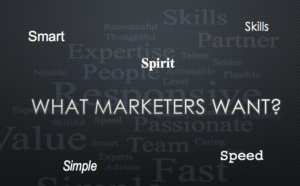
The conversation eventually made its way into a discussion of relationships they had with various consultants, advisors, and agencies. Just for kicks, I built a word cloud from my notes and saw five themes emerged around what they wanted from a vendor — I call it the five “S’s”.
Smarts – this was a common theme — “I don’t want to have to explain my business to the vendors that I work with. They need to do their homework.” Almost every conversation had an element of the client wanting vendors to be up to speed when the engagement started. Time is money and clients don’t have the time (especially on their dime) to get you up to speed. And, for big consulting firms and agencies, don’t get comfortable with thinking you have a lock on all the brightest folks. They use plenty of very smart individual contractors. Many of them, just came from your world.
Skills – similar to the above comment, clients want to work with agencies and consultants that have the skill sets that they can’t find, hire or retain. This was especially important when it came to digital talent. They have made investments in MarTech but are having a hard time finding the talent to optimize, or even operate, the technology…and it is becoming more difficult.
Speed – “I need the vendors I hire to operate at the speed of my business,” said the CMO of a Fortune 50 hi-tech firm and others echoed her comment. There were also comments related to responsiveness. If you’re standard policy is to respond to a clients’ email within 48 hours, you’re about 40 hours off on their expectations. Being more responsive can buy you time on deliverables. Clients want to know, or at least feel, like you’re making progress on their effort. Gaps in communication create the risk of your client feeling like they are not getting the attention they deserve or pay for…and they know when you’re stretched too thin.
Simple – combine Smarts with Speed and you get Simple or at least that is what the client would love. They want to be able to understand your recommendations so they know exactly what decisions, or action, to immediately execute. Consultants — they are tired of the upsell, where one problem suddenly surfaces another problem, especially when they haven’t received the output of the first project. Agencies — the more complexity you add to a campaign the longer clients believe it will take to execute. Smart, valued vendors take complex problems and make them simple to understand and resolve. They know they have other issues they just need to address the problem in front of them.
Spirit – this one surprised me and took some time to understand. The core of this theme was rooted in marketers stating that they wanted to work with vendors who were “enthusiastic” about their business, or “passionate” about their own jobs/role. They want a partner who brings some fun and/or passion that may be lacking in their organization. If you are pitching an idea an important part of the “sell” job is how you deliver it. If you’re not excited about it, they won’t be either. The last thing you want is a client who doesn’t want to talk to you because they know it won’t be enjoyable…they have plenty of those meetings internally. Be their break in the day, the good news, the breath of fresh air they so desperately need…especially at the end of the day or week.
Surprisingly, I didn’t hear cheaper. Don’t misunderstand, they want value and recognize that to get it they have to make the investment. Now that you know what they really want that shouldn’t be a problem to deliver, be the bright spot in their day.
We’ve all had those trips. An important business meeting takes you to a new city, perhaps on your bucket list, and all you see is the airport, skyline and a conference room. Here are some thoughts on how to get the most out of your business trip in 5 popular cities.
Take A Train that Feels like a Boat Ride – skip the flight and take the Acela from New York to Boston. The views along the coast are fantastic and the stretch of track along the Connecticut coastline is stunning. The train literally crosses three beaches and there is a section around New London, CT that you will be over so much water, for so long, only a few feet above it, that it feels like you’re on a boat. Do it soon because they’re talking about rerouting the train to increase speed between the cities, that would move it off the shoreline.
Balance the Bad with the Good in San Fran – too many trips result in hours of sitting in a windowless room all day eating crappy hotel food. To do that in a city like San Francisco is downright criminal. Here’s how to get the best out of a bad situation. If you can, avoid the conference hotel and book a room at the Harbor Court Hotel or Hotel Vitale on Embarcadero, near the Ferry Building. Counter balance the high calorie, low nutrition hotel food, by going for a run. Start across the street at the Ferry Building and head north to Fisherman’s Wharf, just listen for the harbor seals. Go south (right facing the building) and you can run around AT&T Park. Not a runner? No worries. Connected through a door from Harbor Court is the YMCA with a pool on the second floor, yoga & spin classes, etc. If you stay at the Hotel Vitale, book a soaking tub under the stars at the roof top spa to work out the kinks from sitting all day. You’re also at the right spot for great restaurants. Skip the conference dinner and head to the Ferry Building for seafood at Hog Island Oyster Co, or an organic vegan meal at The Plant Café If you have to eat at the conference, push the food around on your plate like a 5-year-old staring down lima beans, and then take the side exit for tapas at Michael Chiarello’s Coqueta on Pier 5.
Experience Las Vegas Sans Casinos – ah, the Vegas conference scene, three days of non-stop overstimulation. Here’s a survival plan. Stay at the Elara. It’s on the strip, but adjacent to the Miracle Mile shops. The best part, great location, no casino…no noise, it’s an oasis from the onslaught. As for things to do off the strip, check out The Auto Collections at the LINQ Hotel & Casino…off the beaten path and a little hard to find (it’s on the top floor of the parking garage). The collection features Elvis’s Cadillac Limo and several cars from movies, including the original “Herbie The Love Bug” and several cars from “Gone in 60 Seconds.”
Do Europe in a Weekend by Extended Your Stay in DC –this one takes a little (or a lot) of imagination. Fly into and out of Dulles Airport (IAD). Book a car at the airport on Friday and head to the “French” countryside and stay at the Hillbrook Inn in Charles Town, WV. Hillbrook was built by Brigadier General Frank E. Bamford, on land George Washington once owned. General Bamford modeled his home after an inn he loved in Normandy, where he stayed after WWI. Around the corner is “LeMans”, (Summit Point Motorsports Park) where you can watch a race or schedule some track time with your rental (I’ll never tell). In the afternoon head to “Monte Carlo” (Hollywood Casino) and do some gambling. From there it’s off to “Germany” in Shepherdstown, WV. Book Saturday night at the Bavarian Inn overlooking the Potomac river. The following day walk to “Transylvania” and spend the day in the town called the “Most Haunted Town in America” and subject of the Destination America TV series, “Ghost of Shepherdstown.” Or skip town and head back towards the airport, stopping in the historic town (and National Park) of Harpers Ferry (a 20-minute drive). Make your way back to Dulles, via Route 9, traveling through the “French Wine Country” region of Northern Virginia. You’ll pass 8 vineyards during the short journey (less than 30 minutes) back to the airport. If you’re running short on time, all the locations listed above are within an about hour of the airport.
Book a Room With a Stunning View in NYC – no doubt there is a lot to see on the NYC skyline. Here are two you might not think of but provide Instagram worthy views. The first is the INK 48 hotel in Hell’s Kitchen on 48th and 11th. The Press Lounge on the 16th floor offers an incredible view of the Hudson River and the city (in particular Times Square). In the Financial District, stay at the Millennium Hilton, and ask for a room facing the 9/11 Memorial for a stunning view of the new Oculus transit hub and the memorial park.
Business travel can be a necessary evil, but occasionally, it can have an upside if you plan ahead. If you have ideas on how to improve the travel experience, please share them in the comment section below.
Did you know, that until recently restaurant owners only cared about the cleanliness of the food prep area? Most customers, and owners, assumed that if someone got sick after dining out it was because of food poisoning. That was until Carbon Design and Challenger Inc. helped “challenge” the norm by showing owners that half of the outbreaks in a restaurant were caused by people to people transmissions.
Now owners know where the “hotspots” are, and as a result, restaurant are cleaner than ever. Grab your face mask and enjoy a safe night out, but you may want to avoid the raw oysters 😉.
CASE STUDY
How do you do it? By giving clients and users what they want. Using the remaining budget that was to be used to update the site with the new branding we designed and built an entirely new site on a new platform. But audience needs are constantly evolving so the work never stops. Our team continues to audit performance and make improvements.
As a result, the two-year journey has paid off with the site being named #1 in the industry. Even more importantly, their key priority areas (site search, attorney profiles, etc.) were ranked in the outstanding category. Proving that excellence is a journey not just a destination.
CASE STUDY
It’s not unusual to find companies referring to their relationship with clients as “partnerships.” It’s common to find client logos on vendor websites. But how often do you see an agency or consulting firm’s logo on client websites? If you visit www.evepark.ca – that’s exactly what you’ll see.
Carbon Design, represented side by side with, a global architecture powerhouse, a world-class designer, and the project principal: the innovative green-tech engineering firm, S2E Technologies Inc. Under S2E’s leadership, these firms are inventing a new consumer category – one that integrates bold new ideas about housing and transportation – and radically resets the carbon footprint of both at the same time.





 We’ve tried surveys, but they say one thing and then do another. One on one sessions, yep, tried those as well. How do we really know what our clients want? Over the last few months, I’ve had the opportunity to speak with close to fifty marketers, friends, clients and former colleagues. I didn’t have an agenda or a pitch, just a conversation about their career path and how they decided on their professions.
 We’ve all had those trips. An important business meeting takes you to a new city, perhaps on your bucket list, and all you see is the airport, skyline and a conference room. Here are some thoughts on how to get the most out of your business trip in 5 popular cities.


