Marketers, channeling their inner Maverick (Tom Cruise’s character in ‘Top Gun’) often find themselves thinking “I feel the need, the need for speed” but are plagued by internal speed bumps and stop signs. Little do they know that buried in Jeff Bezos’ annual shareholder letter is an approach for helping them accelerate marketing efforts, and navigate past internal road blocks.
Working with hi-tech clients, I learned the necessity for quick execution. Pipelines must be filled, leads progressed and converted, and quotas achieved. IBM had two “mantras” when it came to accelerating marketing execution. The first was the rule of “70%” and the second was “Fail Fast.” Once you had roughly 70% of what you needed (information, insight, etc.) to execute you then got into the market, letting the results refine your program and thus quickly course correcting. Built on the idea of the yield curve, the greatest gains in progress were made during the first 70% of effort, refining the remaining 30% being too costly and time consuming.
“Failing fast” was built on the idea of quickly testing “concepts” or theories. If IBM wanted to experiment with something new or different it would construct tests to quickly measure results to either scale or kill the program. These two guide points have influenced my thinking over the many years.
So it was interesting to see Jeff Bezos picking up on these same principals in his annual shareholder letter. Except he added his own twist. In his letter he warns of becoming a “Day 2” company. He defines Day 1 companies as obsessed with customers, skeptical of proxies, eager to adopt new external trends, and perhaps most importantly, their ability to make high velocity decisions. For him, Day 2 companies become static, quickly becoming irrelevant and out of business eventually. The key to staying in “Day 1” is the ability to move quickly, experiment patiently, accept failures, and “double down when you see customers delight.”
Bezos believes that there is no “one-size-fits-all” to decision making but rather “two-way doors” where decision can be reversed. Those decisions in his words use a “lightweight” process. It starts with what he phases as “disagree and commit.” Given the growing number of stakeholders in the decision-making process, could this be the secret marketers have been searching for to eliminate speed bumps?
As Bezos describes it, “If you have conviction on a particular direction even though there’s no consensus, it’s helpful to say, ‘Look, I know we disagree on this but will you gamble with me on it? Disagree and commit?’ By the time you’re at this point, no one can know the answer for sure, and you’ll probably get a quick yes.”
Giving the success of Amazon, this is a piece of advice we should all heed. For marketers, the key to making this approach work is “conviction.” It means doing your homework, having the facts to support your point of view, and the courage to take a risk. Going fast brings with it the risk of failure, but as Bezos states “being wrong may be less costly than you think, whereas being slow is going to be expensive for sure.”
And Mr. Bezos knows a thing or two about flying fast. On the day he released his annual shareholder letter, Amazon stock closed over $900, up 50% over the year. Need any more proof that this “maverick” got it right?
Pat and I shared our key learnings on executing Challenger across a multitude of marketing activities: customer understanding, marketing messaging, content strategy development, content and sales tool production, and lead generation.
On March 8th at 11 am (EST) Jessica Cash and I will be presenting Using B2B Content to Drive Alignment & Accountability, details on the event and registration below.
Overview:With increased budgets comes increased calls for accountability. Today’s top marketers are using Commercial Insight, personal value, and help from peers to craft content strategies that result in more than just customer engagement. Learn best practices and ways to avoid common pitfalls that often leave marketers struggling to improve lead quality.
Join Jessica Cash, Head of Sales and Marketing Solutions Product Development at CEB, and Scott Gillum, President of gyro in Washington, D.C. as they answer questions, such as:
How can marketers avoid always defining their business solely from the legacy perspective?
How does redefining themselves allow for better alignment with customers?
How can value drive customer action?
Jessica and Scott will be holding up the mirror in order to show how CEB is applying these best practices and principles in their own marketing efforts, so come ready with questions!
We are emotional creatures living in a highly emotional world as recent events have shown. It’s a time when people often act, or react first without having any, or all, of the facts. And the media may (or may not) be reading more into things than are actually there.
Take for example, Budweiser’s “Born the Hard Way” Super Bowl ad. It tells the story of Adolphus Busch’s journey from Germany. The ad, released last Tuesday hit the air at the height of the controversy surrounding President Trump’s travel ban. The 60-second ad starts with a shot of Busch and a voice in the distance saying “You don’t look like you’re from around here.” Whether it’s intentional or not, the immigration themed ad struck a cord with many.
Although Anheuser-Busch InBev denies any political connections, others have used it as rallying cry. As an ad, it ‘s well done and hits many of the important elements of quality advertising. It’s an authentic (despite being somewhat fictionalized) story of the American success story told through the founder’s journey to St. Louis as a German immigrant.
The challenge is that it may not connect with its audience. More bluntly, it may have pissed off a lot of Bud drinkers. Here’s what the agency strategists and A-B InBev may have missed during the creative concept process.
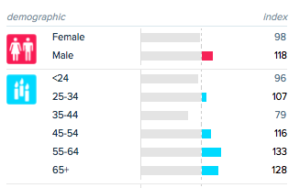
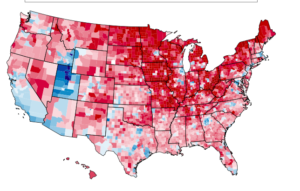
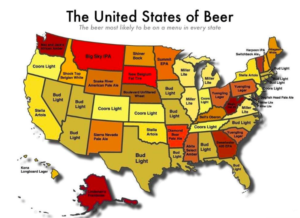
Overlay the map below with 2016 Presidential election results map (by country) above and you will see that of the 13 states where Bud Light is the most popular beer, Trump won 9, and of the remaining four, Trump won the rural vote. In fact, the profile of a Bud drinker is almost identical to a Trump voter.
The risk for Budweiser, in its desire to reach and connect with Millennials (77% drink something other than Bud), is that they may have alienated and/or offended traditional Bud drinkers. The day before the Super Bowl saw a ground swell loyalists threatening to #boycottbudwiser (yes, spelled incorrectly). The hashtag trended the night of the Super Bowl and the following day after. Once corrected, the hashtag became a lightening rod for comments both supportive and critical of the theme. Bud fans seemingly upset at what they see as Budweiser making a political statement.
It’s a classic big company conundrum. In order to ensure growth, Bud had to swift its messaging towards a younger audience at the risk of alienating its loyal customer base. The question for Budweiser now is did the ad do its job. It was voted as one of the “Winners” of the evening but did it convert non-Bud drinkers? And in this highly competitive marketplace, will the ad be effective in bringing new younger buyers to the brand at a rate to cover the loss of consumers who may be switching their allegiance because of their outrage over its political overtone?
The takeaway for agencies: We now have to consider the potential for ads to be “hijacked” by a political controversy. As a result of the polarization of America, agencies and companies may know have to consider how their audience voted (see the campaign map) when crafted campaigns. The other insight is that we may have found a new way to use emotions to trigger action, for better…or worse.
‘Tis the season for Christmas catalogs. Tons of them roll into mailboxes across the country and, shortly thereafter, into recycling bins. In our house, two catalogs escape this fate but for different reasons.
I am an “all-in” fan boy of the Patagonia brand. In my opinion, Patagonia is THE most authentic brand in the world. “Worn Wear” is probably its best brand campaign ever, and “Unbroken Ground” the best product launch campaign.
I believe in the company’s causes, point of view on the world, anti-consumerism message – all of it! The catalogs are as much about adventure and causes as they are about the clothing.
The other catalog that escapes the recycling bin, at least temporarily, is Orvis. Its prominently-displayed coupons on the cover have me at “hello.” “Free money” works for me – so much so, I’m conditioned to respond to a coupon that the last time I bought something without one I developed a rash. Yes, I know the discount is baked into the price, but it works. I peruse the catalog looking for an item to apply the discount as soon as the catalog arrives.
So here’s the difference: while I spend more time reading the Patagonia catalog, I buy more from Orvis. In fact, despite my love for the brand, I don’t own any Patagonia clothing. In the business-to-business (B2B) world, I am what you would call a “false positive.” I’ll consume your content all day long but I won’t convert. And in today’s world of deep targeting and conversion-focused metrics, I might get missed.
Brand advocates, like me, are incredibly important for B2B brands. In the book, “The Challenger Customer” by Brent Adamson and others, I would be described to as a “mobilizer.” Mobilizers advocate for brands with other decision makers within the decision-making team. In fact, the likelihood of a closed deal increases dramatically if you can find one to champion your brand.
In our home, I’m the brand advocate and economic buyer and my son is the user. The reason I don’t buy Patagonia is that I believe their clothing is more of a fit for a teenager who refers to it as “Fratagonia.” I’m more the Orvis generation, but I alert my son to things I think he would like because, unlike me, he spends zero time looking at “old school” offline catalogs.
This same pattern is repeated in the business-buying world. Brand advocates will spend hours reading your content, watching your videos, and attending your events. They’ll show up in Salesforce as leads but will never advance, causing frustration for sales reps and managers. So why shouldn’t we dismiss them? They’re also the ones who will recommend your brand to a colleague who is searching for a vendor to fit a need.
The challenge has been identifying and targeting “mobilizers” as described by Adamson and his colleagues. After spending about a year trying to figure this out, we’ve discovered three “markers” that might help lead you to these mystical influencers.
Consumption of long form content. In a world moving to shorter and shorter content, mobilizers will invest time with your content. They’ll spend the seven, or even twenty minutes, to view a video if it’s well done. And don’t take all of the long form content off the website just yet. These folks will consume and summarize key points for others. Pay special attention to time spent on the page, along with visitor viewing habits on heavier content pages.
Repeat visits over a longer period of time. Buyers who are in the decision-making process have a tendency to “burst” visits. They’ll hit your site in rapid succession and consume a large quantity of content over a brief period of time. Brand advocates – like mobilizers – consume content more consistently over a longer period of time. Watch and track your repeat visitors, and see if they are also subscribing to your e-newsletter, attending webcasts, etc. You need to track and trend these visitors over the year (or even two).
Sharing habits. Another trigger for tracking these influencers is the sharing of habits. They’ll share content they find to be meaningful. Take a look at consistent content sharers. Make sure you have them identified in your ABM programs. Build email campaigns with content links that are intended to travel, and watch where they land.
Make sure you can aggregate all of the activity mentioned above against a single profile. You’ll need all the data to identify mobilizers. The other homework assignment is to take a hard look at your organization and ask if you have the type of content that would create and energize brand advocates. What does the organization stand for? What is its point of view, its purpose? If it’s “to sell something” or “to make money,” you don’t have it.
Imagine this; you’ve booked a three-day trip to Miami. Would it make a difference in how you pack, the airline or hotel you select, even your mindset, based on whether the trip was for a vacation or a business meeting? Of course it does, and any reasonable person would start with the purpose of the trip and then plan from there.
With the intense focus on developing personas and mapping the buyers’ journey, many marketers are skipping that first piece of the journey, or the “purpose.” Marketers may know the buyer and their purchase behaviors – but they don’t fully understand their “why” or what motivates them to choose their organization.
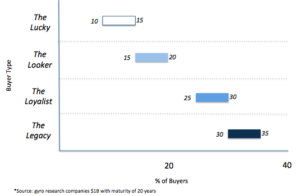
Based on research from a group of clients representing hi-tech, financial and information services with more than $1B in revenue, I’ve pulled together four common buyer groups. This is not intended to be “statistically significant,” but rather a framework for considering the uniqueness of buyer motivations. Try matching your customers to the segments (below). They should be easily identifiable and you may find a similar distribution.
Here is a short description of each group.
The Lucky (10-15%) – prospects that your outbound sales and marketing efforts have reached with the right message at a time when they were open to discussing how you could solve a specific problem or need – a new acquisition.
The Looker (15-20%) – buyers who are actively searching for information/solution that can help them with a need or problem. They find you and decide to engage in the sales process – a new acquisition.
The Loyalists (25-30%) – your “champions” that have used your products or services in the past and faithfully bring you with them wherever their career takes them.
The Legacies – (30-35%) they inherit the existing relationship and may, or may not, be familiar with your products and services.
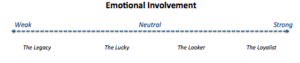
Each group ventures through the journey and engages with sales and marketing channels with a different mindset and set of motivators. It impacts how they interact with the decision-making group and perhaps, most importantly, their willingness to advocate for your brand and/or product. Hence, why you need to consider their emotional involvement in the process. Why? Because emotions fuel the wheels of motivation; they can drive them forward or put them in reverse.
Mapping emotional involvement by segment from strongest to weakest will help you develop an engagement strategy. “The Loyalist” group is motivated to advocate for your brand because they feel an emotional connection. It may have been formed by a past experience, or how it makes them feel about themselves and/or their role. CEB calls this “Identity Value.”
Your communication should reinforce their decision to work with you. Any awards or recognition received should be passed along immediately thanking them for their contribution. Any bad news should be quickly communicated and explained via a call, not digitally. Know this group thoroughly, understand their social engagement and make sure to track their career progress. The relationship is personal, so recognize and reward it.
On the opposite end is the “The Legacy” group. Although they inherited the relationship, they may not be motivated to keep it. The potential issue, according to Sirius Decisions 2016 B2B Customer Experience Study, is that “80% of B2B purchasing decisions are influenced by past customer relationships” and that experience, most likely, was not with your organization.
Assume low emotional involvement and do your homework on this audience. Here are some helpful hints on engaging them. We know from our research on the emotions executives experience in their careers that four emotions are always present, 1) excitement, 2) anxiety, 3) confidence, and 4) pride.
The “word cloud” is taken from research on the emotions experienced when an executive moves into a new role. Take advantage of a “Legacy” person being new to the role and leverage the excitement they feel by communicating how your product or service can benefit them professionally, and personally. Additionally, emphasize how your products and/or services may reduce their anxiety or apprehension that comes with the new responsibilities.
“The Looker” is motivated but may not yet be emotionally engaged with your organization. The thrill of discovery quickly fuels emotions. Continue to feed it by understanding their behaviors and journey. Give them reasons to personally connect to your solution or brand. Use insights to teach them something new about their business, needs, and/or their customers.
The “Lucky” become aware much later, and may never really become emotionally involved. For them this may be purely a transactional relationship. Focus on reducing risk that they may associate with making a bad decision. Use industry-specific case studies and customer testimonials to build their confidence in your capabilities.
If you’ve ever said, “I don’t feel like doing it” you get how emotions impact motivation. Your task now is to understand why your customers take the “journey.” Pushing an organization forward to a purchase decision is a struggle. Your advocate will become fatigued along the way. To win, you have to understand the emotions involved at key moments to motivate them to keep moving because at some point, they won’t feel like doing it either.
Modern marketers are “technology crazy,” constantly searching for the latest innovation to help them optimize the customer lifecycle and gain a completive advantage. For better or worse, marketers have plenty of options to play with, according to Scott Brinker the MarTech landscapes is enormous with 3,874 ISV’s and growing everyday.
In the past, Larry Ellison would of referred to the maturing MarTech space as a “killer field.” With the “Big 5” (Oracle, IBM, Salesforce.com, Adobe and SAP) swooping in like birds of prey picking off niche providers to fill out their product portfolio.
Marketers in the past would have been content with letting the industry leaders pick the winners and losers from this vast field of options. Preferring to consolidate their technology needs with one or two vendors making it easy to have “one throat to choke.” Companies like Oracle, have invested in making acquisition to fill solution gaps in functional areas as they have built their Marketing Cloud.
Unfortunately for Oracle and others, Millennia’s are not behaving the way traditional software buyers have in the past. In fact, there is growing evidence that they are pursuing a “best of bred” approach aimed at stitching together multiple platforms that follows the customer journey. Marketers are arranging their “stacks” either in a linked multi-platform approach, or with a spine in tag management products that hook up to an assortment of specific platforms and ISVs.
These new customer-centric clouds cut through traditional inefficiencies to motivate purchase intent. They are woven on the idea that consumers search for and choose customer-oriented brands, so marketing technology should reflect and enhance this in the evolving digital world. Most clouds only offer targeted suites in functional areas, which create both customer and internal silos. But these hybrid clouds humanize the digital experience and bridge integration seamlessly across all channels and touch points. All customer-facing departments are poised to address the public with a single strategy organized into one set of solutions.
A growing leader in the experience cloud space is Sprinklr, recently valued at $1.8 billion. Sprinklr has a focused acquisition strategy that concentrates on integration and is unlike any other in the business. First off, it doesn’t sweep up tools simply to increase their client base or rapidly grow, but it instead targets how well each can augment the customer’s experience. Sprinklr then completely rebuilds their software onto its own platform to ensure seamless integration.
And this could present a major challenge for the Big 5, as Oracle’s president Mark Hurd calls the idea of perfect integration between its products impossible, adding that, “There will never be a day where the depth of integration, unless it was all built from the bottom ground up, will be as integrated as any of us would like.”
When Sprinklr made its initial acquisition in 2014 of the Dachis Group, it was able to launch the first end-to-end operating system for brand marketing that enhanced customer relationships through multiple channels and touch points. Since then, its business ventures have made it a pioneer in converged media, advocacy, social communities, content management, audience segmentation, and social visualization – all to enrich its clients’ understanding of and engagement with customers.
Even though Sprinklr may be the fastest and most effective solution so far, it’s not alone in the move to deliver this new breed of experience clouds. In 2014, Gartner predicted that 89% of companies would be competing mostly based on customer experience by today, versus the 36% four years ago. The leading cloud giants like Oracle, IBM, Salesforce, and Adobe are starting to recognize this new wave and have shifted their strategies accordingly to offer their own experience clouds but integration remains a challenge.
Salesforce recently acquired Demandware as an integral part of its Customer Success Platform, but it yields weak integration between its various clouds. Similarly, Oracle and IBM are especially vocal about their experience cloud offerings and each present a large number of comprehensive solutions, but they are also limited on the integration front, both internally and with third party plug-ins.
It’s still debatable if there will eventually be “one cloud to real them all” but for now, the successful platforms will be those that can serve as a solid backbone through internal as well as external integration. Or as Sprinklr Founder, and CEO Ragy Thomas states it “Sprinkle, don’t shout. It’s not about who yells the loudest. It’s about who offers the most value in a relevant, nurturing way.”
Did you know, that until recently restaurant owners only cared about the cleanliness of the food prep area? Most customers, and owners, assumed that if someone got sick after dining out it was because of food poisoning. That was until Carbon Design and Challenger Inc. helped “challenge” the norm by showing owners that half of the outbreaks in a restaurant were caused by people to people transmissions.
Now owners know where the “hotspots” are, and as a result, restaurant are cleaner than ever. Grab your face mask and enjoy a safe night out, but you may want to avoid the raw oysters 😉.
CASE STUDY
How do you do it? By giving clients and users what they want. Using the remaining budget that was to be used to update the site with the new branding we designed and built an entirely new site on a new platform. But audience needs are constantly evolving so the work never stops. Our team continues to audit performance and make improvements.
As a result, the two-year journey has paid off with the site being named #1 in the industry. Even more importantly, their key priority areas (site search, attorney profiles, etc.) were ranked in the outstanding category. Proving that excellence is a journey not just a destination.
CASE STUDY
It’s not unusual to find companies referring to their relationship with clients as “partnerships.” It’s common to find client logos on vendor websites. But how often do you see an agency or consulting firm’s logo on client websites? If you visit www.evepark.ca – that’s exactly what you’ll see.
Carbon Design, represented side by side with, a global architecture powerhouse, a world-class designer, and the project principal: the innovative green-tech engineering firm, S2E Technologies Inc. Under S2E’s leadership, these firms are inventing a new consumer category – one that integrates bold new ideas about housing and transportation – and radically resets the carbon footprint of both at the same time.

 f what you needed (information, insight, etc.) to execute you then got into the market, letting the results refine your program and thus quickly course correcting. Built on the idea of the yield curve, the greatest gains in progress were made during the first 70% of effort, refining the remaining 30% being too costly and time consuming.
 became a lightening rod for comments both supportive and critical of the theme. Bud fans seemingly upset at what they see as Budweiser making a political statement.