by scott.gillum | Jun 10, 2014 | 2014, Marketing
Tell me if you have heard this before; “we need more, and/or better leads.” The chances are, if you’re in hi-tech marketing you may hear it on daily, weekly and monthly basis. Why? According to Forrester consultant Tom Grant, it’s because of the need to feed the funnel.
In his report Tech Marketers Pursue Antiquated Marketing Strategies Grant compared hi-tech firms to other industries “B2B technology companies treat marketing as an opportunity to sell new products and services to new customers.” As he stated “the product is the axis around which marketing efforts turn,” and as a result, the primary objective of marketing is to produce leads.
Similarly, marketers have long held the belief that because of sales short-term focus on making quarterly objectives, it either lacks the appreciation of, and/or the sophistication to understand anything other than lead gen, for example longer-term brand building and awareness activities.
But what if both of these viewpoints were actually wrong. What would happen if you asked sales what they valued, rather than assumed you knew the answer? How might it change how marketing thinks about its impact on the organization?
For one B2B Tech Company, feedback from the sales force is helping them refine their value to the organization. “When it comes to enabling the sales force, we’ve previously relied on what I call “measurement-by-anecdote.” Our goal with this study was to quantify what sales values from marketing so we can focus on the things that make a difference.” said Rick Dodd, SVP Marketing of Ciena, a $2 billion global optical and packet networking company.
To gain that insight the company surveyed its global sales force, including five types of sales reps covering five different account types. Over 400 sales reps provided feedback on their priorities for marketing and marketing’s performance.
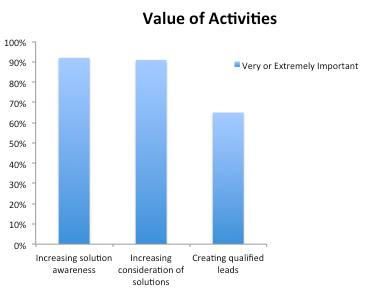
According to sales, the highest ranked marketing activities were at the top of the funnel, 92% of sales said that increasing the awareness of solutions was very or extremely important, increasing consideration was close behind at 91%, only 65% mentioned lead generation.
“Our sales force is very experienced; they understand that technology and industries change quickly. We’ve obviously been successful positioning ourselves for today’s market, and now we want to take best advantage of the big shifts in our landscape. The survey showed us that for sales to be successful, marketing has to be able to change customers and prospect perceptions,” according to Dodd.
Perhaps the most interesting insight to come out of the research, is how Ciena is now thinking about measuring and reporting marketing’s impact on the organization. “Measuring pipeline value is a struggle in our business”, said Bill Rozier, VP of Marketing. “We have long, complex sales cycles that make it difficult to isolate marketing’s impact.”And they are not alone it in that challenge. The Aberdeen Group’s recent Demand Generation study found that 77% of respondents rated visibility into lead performance across stages as very valuable, but only 43% indicated they can do thi effectively.
Instead of spending a lot of time and energy in trying to perfect an imperfect process, thecompany is focusing efforts on measuring marketing performance at the macro level. “At the end of the day, our performance is ultimately measured in sales success, so that’s what we are focusing on measuring”, said Rozier.
To do that, the company has created a quarterly dashboard from the survey. Two regional sales organizations each quarter will be asked to evaluate marketing’s performance in three areas: 1) Marketing’s contribution to sales success; 2) Marketing’s performance compared to competitors; and 3) Marketing’s contribution to the success of the organization.
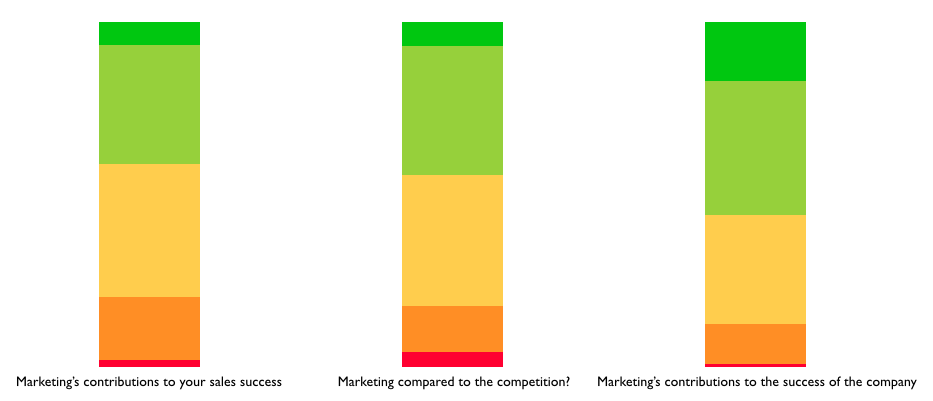
It’s a unique approach, and perhaps one that should be considered by others, because the challenge in performance management is often in defining the right metrics to drive the intended behaviors.
Ciena’s approach, as Dodd concludes, is to put the focus on the right conversation; “As we learned through the research, contributing to the success of the sales force isn’t just about one thing, it isn’t just lead gen. I appreciate that they give us credit for doing a good job when compared to competitors, but what we’re most interested in understanding is how well are we doing in enabling them to win. If the sales team rates our contributions as being valuable to their personal success, then we know we’re doing the right things.”
by scott.gillum | Jan 28, 2014 | 2014, Marketing
In December, I had the opportunity to be the Keynote speaker at the Bowery Capital CMO Summit in NYC. The event featured a number of high profile CMO’s speaking with an audience of mostly early stage startups (under 20 employees).
My presentation was based on the recent Forbes blog post Everything We Thought We Knew about B-to-B Marketing in Wrong. The audience also included some local media, a reporter from CMO.com wrote a summary of the speech.
http://vimeo.com/82457497
by scott.gillum | Dec 2, 2013 | 2013, Marketing
My initiation into the world of sales happened at the height of the “Glen Garry Glen Ross” days. It was the time of “blue suits” and “fast talkers”, and not a piece of sales automation or tracking technology anywhere to be found.
We’d roam our territories searching for conversations hoping it would lead to something more. At the end of the day, we’d return to the office and put our “numbers” up on the board; # of conversations, # of leads, and closed deals ($). The white board was our “sales dashboard” highlighting performance against goals for the month, and year-to-date. Our view, and control over our success, was determined day-to-day.
Over the last 25 years, sales has been enabled with a broad set of new technologies, from sales force automation to CRM to cloud based mobile sales tools. All aimed at helping the sales organization better track, measure, and achieve quota. And with each advancement in technology, sales has gained the feeling that it has more control over the process, and outcome.
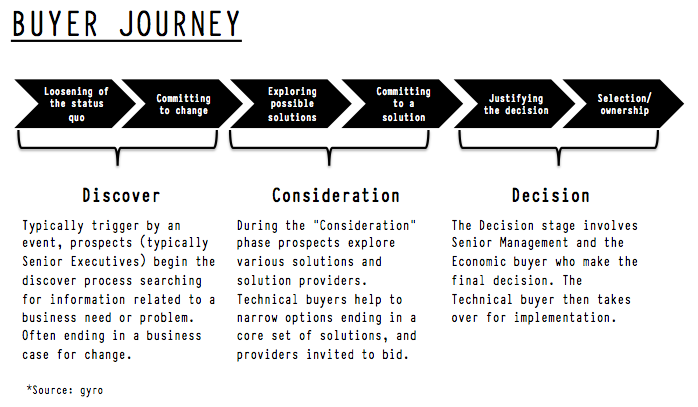
The buyer’s journey is marketing’s “shiny new penny”. Over the last couple of years, numerous consulting firms have produced research trying to map the journey with varying estimates on how late in the journey customers are now engaging sales.
Before you go off preaching this newfound perspective on how buyers are now in control to a sales organization, who might just have a counter viewpoint, there are some things you need to know:
- This is not necessarily “new” news – educated buyers have been engaging late in the process for years, and in some cases, bypassing the sales reps all together ordering direct. What’s different now is that we have better tools to track their behavior.
- It can be threatening – sales folks “cover” buyers, be it a prospect or an existing customers. Their job is to start a conversation and to continue the discussions to, hopefully, a successful outcome. They can’t be everywhere, or everything to everyone, but to suggest that they are not providing buyers with the right information at the right time, or that they may not be “covering” them will cause a defensive or hostel reaction. Be tactful in the way you present the findings.
- Buyers channel surf – don’t assume that buyers are only online in the early stages of the buyers journey, and likewise, that they are only talking with sales in the late stages of the process. Unlike the past, when we could estimate where customers were in the sales process by watching how they engaged with content and channels, buyers now use all channels, and all information sources, at all stages of the journey.
- Good sales people already get it – good sales people are very intuitive by nature. They already have a feel for how buyers research and purchase products. They also know how to use the best content and/or tools to help buyers advance their learning and to move the process. As a result, they will want to know how you can help them.
- Have a Plan – especially for the sales people I just mentioned. The question that you should expect to get after sharing the information is; “So what now? Given this new insight how should we change our sales and marketing approach.” Make sure you have an answer.
My gut reaction was that the buyer’s journey would pose a significant change for sales, I now realize that it’s a much bigger challenge for marketing. Given the amount of time spend online in the research phase, buyers already have a good feel for the “business value” of your product or service by the time they engage sales. It’s why they have put your organization in the “consideration set.”
The challenge, according to recent research, is that buyers are unable to differentiate your product or service from the 3-5 other companies they are also considering. To create separation, you must be able to illustrate and communication “personal value”.
And that has not been a strength of marketing, but it’s a core competency of good sales people. Use this opportunity to partner with sales to developed content that resonates with buyers on emotion level deeper into their journey. Sales may be losing control over the buying process, but they know how to connect on a personal level with individual making the purchase decision, use that to your advantage.
by scott.gillum | Sep 22, 2013 | 2013, Marketing
Do you think the senior executive team is excited about the big lead generation campaign you just launched? Nope. How about the number of “Likes” on your corporate Facebook page? Think again. Marketing doesn’t matter in many organizations, because it thinks, operates, and worst of all, reports “small.”
Executives sitting in the “C-suite” got there by thinking big, managing big, and reporting “big”. Marketers commit hari-kari with this group by reporting tactical level activities – “minutia,” that garners no ones attention. Do you think the head of sales is reporting the number of sales calls reps make a day? No. If you want to get their attention, you have to make marketing more important to them. Here are five ways to go “Big.”
- Big Bets – if you want marketing to be valued you have to understand, and link, to what the organization values. It’s that simple. If it’s market share, connect marketing objectives and activities to acquisition or/and account penetration. If it’s profit, understand the drivers and align your teams’ efforts appropriately.
- Big Strategy – once you understand how to link marketing to the business objectives your job is then to connect those big bets to day-to-day marketing activities. Your smarts will be needed to take the marketing requirements from the product and sales organizations (which may be very tactical) and link them to the overall marketing strategy that aligns to the “big bets.” Warning – this will require math, perhaps lots of it.
- Big Plays – to execute, organize your marketing objectives as defined by your internal stakeholders into 2 or 3 “big plays.” If market share is a key growth objective, a big play should focus on an area that has the greatest opportunity to do that…a specific market, product and customer. All marketing activities/campaigns should be nested around that “play.’ Messaging is critical here because it is the “big play” wrapper that creates consistency in the communication across execution –think “Smarter Planet.” IBM discovered years ago that the best performing campaigns stayed in market the longest, and had the highest level of integrated tactics. It takes focus and discipline to do, but if you can get there it will make your life easier by allowing you to organize everything under a big play umbrella, and if things don’t fit…then maybe you don’t do it.
- Big Results – the first rule here is to understand that measurement and reporting are different. Measure everything, but only report “process” or “results” metrics. Executives care about “outputs,” not “inputs.” Inputs are activities, outputs are results, know the difference.
- Big Balls – ya gotta have ‘em. You are going to have to get comfortable with, and embrace risk. If you do this right, you will be placing bets, that at the time, you will not know how, or if, they are going to pay off. Years ago, I worked with a CEO that committed to double the size of the business in three years. The CMO calculating sales cycles realized to support that growth marketing needed to double the number of leads that year. She had no idea how she was going to do it, but it caught the attention of the senior management team, focused her team, and it happened. But as she learned, you don’t try to go it alone. Reach out to others with your plan, get their buy-in and support. Level set expectations on timing and performance, it may require a significant investment in time and money for the “big bets” to pay off. Set big goals, but be realistic in getting there.
The time for going “big” is now. In Forrester’s recent B2B CMO’s Must Evolve or Move On report, 97% of marketing leaders who were survey agree with the statement that “Marketing must do things that is has never do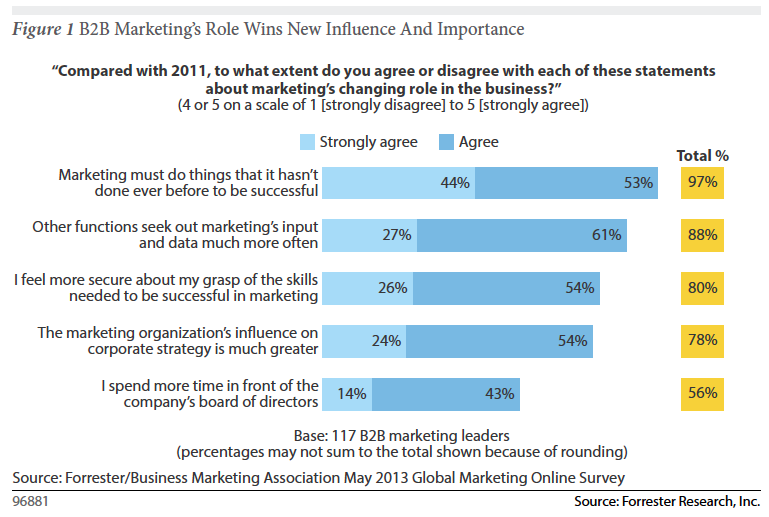 ne before to be successful.”
The other interesting, and important nugget from the research is that marketing is playing a bigger role in influencing corporate strategy, and other functions. Make sure you’re capturing this opportunity at your organization by thinking, and by being — “Big”.
by scott.gillum | Feb 19, 2013 | 2013, Marketing
You know the question is coming, because it comes every year. You know who is going to ask it, because they ask it every year. It’s just a matter of when, perhaps at the end of a difficult quarter, or during a mid-year review meeting. As budgets are being discussed it comes; “What are we getting from our marketing dollars?”
It’s a fair question to ask, and given the size of some marketing budgets, marketers should be asking the same question. To answer the sales executive (usually the one asking the question) you must first recognize what they are really asking, which is; “what is the value of marketing to them?” Specifically, they want to know the impact marketing is having on sales performance, beyond leads.
A few years ago, we did some interesting research for a medical equipment manufacturer. Their analysis showed that they were missing opportunities but they couldn’t agree on why – was it a sales or marketing issue?
To uncover the answer we interviewed hundreds of buyers (customers and prospects) in order to rate the performance of the company compared to three competitors, at four stages of the pipeline, product awareness (unaided), consideration, proposal and win. We then constructed a quantitative model to reflect the impact of changes in performance. Two years later, we were given a unique opportunity to measure the impact of recommendations and investments.
The research yielded three key insights on the importance of marketing and how it was impacting their sales success:
1. Increasing Opportunities – without marketing support sales cannot move consideration rates. The company’s unaided product awareness rate was 62%, compared to 88% for the market share leader. The consideration rate was even worse at 46% compared to 86% for the leading competitor.
The organization had a strong sales culture. So to demonstrate the need to increase marketing activity, and not just sales coverage, we included “relationship with the sales team” as a key consideration drive, along with typical drivers such as; price, brand, and service.
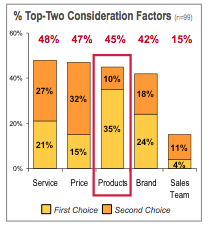
The research showed that the relationship with the sales team was not an important consideration driver. In fact, the data revealed that reps could do very little to change buyers’ perceptions relating to products and service. It also revealed a new buyer that was not being reached by the sales force.
The company increased the marketing budget and reallocated funds from events into digital marketing. They ramped up webcast, videos and built a microsite specifically for this new buyer. As a result, Awareness rose 17 percentage points to 79%, and Consideration, originally at 46% rose to 62%. The model showed that an incremental 1% change in consideration rates yielded 20 new opportunities, and almost four new wins with a value of almost $2M.
2. Sales Coverage – increased marketing activity can create the perception of greater sales coverage. Buyers were asked how often they saw a sales person within a 90 day period. They mentioned seeing the company reps on average of 0.8 times, basically once a quarter, while reporting rep visits from the leading competitor at 2.5 times, almost once a month. Two years later, buyers stated seeing the company’s reps 2.4 times per quarter, on par with competitors. As a result of the ramped up marketing efforts, buyers perceived an increase in visits despite the fact that the number of reps in the segment remained the same over the two year period.
3. Sales Enablement – marketing can identify shifts in buying behavior. The company’s performance had increased in all stages of the funnel except for one, existing accounts Reps had mentioned that customers had become more “price sensitive” and competitors were undercutting them. The company was the product leader in the industry and the senior management team still believed that technology innovation was the key consideration driver.
The follow up research found that the sales force was indeed right. Buyers had shifted their priorities. With changes in reimbursement, healthcare reform, and an effective competitor campaign against overbuying technology, buyers had indeed changed, much faster than anyone suspected.
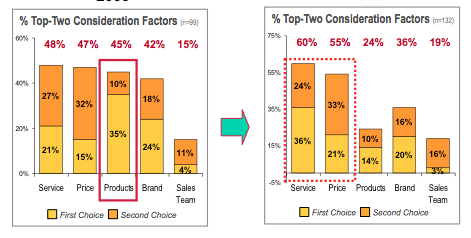
As a result, sales material and value proposition had to be updated quickly. Instead of espousing the virtues of innovation, it now needed to help buyers justify the investment. Leading to a shift from “bells and whistles” to “ROI models and product configurators.”
So, how do you communicate the impact marketing has on sales performance? Tell the sales folks that marketing can identify new buyers and influencers, increase the number of opportunities reps see, improve a buyers perception of sales coverage, and enable them with the right value proposition at the right time to win the deal. Of course, you’ll need the data to prove it.
In this case, the increased marketing investment and activities yielded $50 million in new sales over the two-year period…just as the model predicted.


