by scott.gillum | Dec 17, 2012 | 2011, Tech Trends
Original post date 11/29/11
With the Christmas shopping season fully upon us, Microsoft’s Kinect motion-sensing game device is expected to be at the top of the gift list for many consumers. Last year, Microsoft sold 1 million Kinect devices for its Xbox 360 in 10 days, and in a recent poll it was at the top of the wish list for children 13 and older. But what you might not expect is that some of those orders are going to be coming from businesses.
Early this month, Microsoft launched Kinect for Windows SDK with a brilliant, new ad called “Kinect Effect.
The Kinect Effect TV Ad
Microsoft is pushing Kinect hardware for Windows SDK for business applications. As staff writer Jason Kennedy from PCWorld states: “SDK will make it possible for programmers and dreamers from the world over to tinker with the system and make it do things Microsoft hadn’t thought of, and push the development of NUI [natural user interfaces] to the next level.”
What is noteworthy about the Kinect Effect ad is what it took for Microsoft to make it. Six years ago, in an interview with CMO magazine, Microsoft CEO Steve Ballmer confessed to a problem long known by many consumers of Microsoft products:
During Microsoft’s climb to the top of the software industry, rapid-fire product cycles often happened without much front-end input from the folks in marketing. Engineers would develop new software, pack it with bells and whistles, decide on an acceptable number of bugs and toss it over to marketing for a press release and a launch event.”
At the time, Microsoft had set out to change that course through an expansive and expensive relationship marketing initiative. Internally, it aligned marketing with product groups, created a “mea culpa” marketing campaign to reach out to past customers, and targeted loyalists hoping to turn them into advocates.
But because of its past transgressions, and a perception that many of its products were “necessaries” with little to pique the desire of consumers, Microsoft struggled with finding an ignition point, or something to connect customers with the brand and ignite their passions.
Well, those days appear to be over. With the Kinect Effect, the tech titan proves that it can be relevant, even desirable, with a campaign that is expansive, inspiring and incredibly human. The campaign asks audiences to dream about how they might use Kinect by inspiring them with images of people playing air instruments, a doctor flipping through X-rays, and a student deconstructing DNA with only hand motions.
The expansiveness of the idea allows Microsoft to reach, and hopefully inspire, all three of its targeted audiences, including consumers/users, businesses and developers. Any one group can have the dream, but all three are needed for it to become reality.
Perhaps the most significant point of the ad is that it’s proof that the relationship marketing effort was a success, Microsoft now understands the strategic importance of the “front end” as Ballmer calls it. Five years ago the message of the commercial would of been about the “bells and whistles” of the Kinect device. This ad is an elegant and visually stimulating vision of what Kinect can enable, the virtually unlimited imagination of dreamers.
If Microsoft can continue to build this connection with the customer while retail store openings roll-out into 2012, it could transition itself from the company that makes the “have to have” product to the company that is the “want to have” brand.
by scott.gillum | Oct 22, 2012 | 2012, Marketing
If you did something 400 times you would think you would be able to get it right at least once.
Not always, as we learned after being called in to help a well-known company draft their corporate value proposition…after they had already attempted 400 versions unsuccessfully. True story.
Outside of delivering consistent financial performance that meet expectations, creating an effective and impactful “Why Us” value proposition is the biggest challenge for most organizations. That 30 second blurb that explains to a prospect or customer who you are, what you do, and how you are different.
Why is it so hard? Companies are engaging with customers every day, and pitching their wares to new prospects just as often. Then why is it so hard to come up with a compelling and agreed upon “Why Us” story? Well, feel free to pick any one or more of the following reasons:
- Ownership – it’s everyone’s job…and no one’s job. The organization debates who should create the story, and as a result, it doesn’t get done or…
- Versioning – the good news is the company has a story. The bad news, there are many of them, none of them the same, and a new one is created for just about every new sales meeting.
- “Inward-out” – the story using internal jargon, it’s too long, reflects the company’s views, and not the needs of the customer or prospect.
- Non-differentiated – it focuses on the features of the product or services and not the benefits delivered to customers. As a result, it sounds just like everyone else in the market.
- “Same Page Syndrome” – this is the most fascinating of all. The folks responsible for putting together the story bring their own perspective on what the story should be. Using their own experiences, their role, and their history with the company, they all bring a different view on what the company does and why it’s unique. As a result, no one can get on the same page to describe the organization and its value…resulting in 400 rounds of edits and/or multiple versions.
Given this situation, how to do you get it right?
- Ownership – this is a collaborate process but marcom/corporate communication should own it. They are in the best position to understand the brand value, audience needs, and are responsible for external communications. Corporate starts the process and then cascades it down the organization to add more detail. They own the final version and the governance process to lock down “version de jour.”
- Go outside – start with doing external research looking at your target audience and industry competitors. This will help you understand “tablestakes,” how to define value, and differentiate services. It should also help eliminate the “internal speak.” See below.
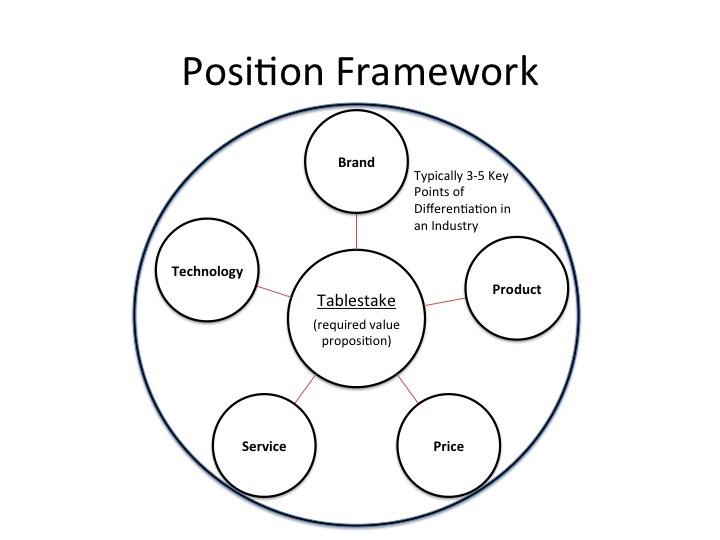
Evaluating the Market
- Get on the same page – for many organizations, this is THE challenge. Before attempting to draft anything, get ALL key stakeholders to agree to ONE of the following. (Michael Treacy and Fred Wiersema conclude in their book The Discipline of Market Leaders that exemplar companies leverage one of three value proposition types: operational excellence, product leadership, and customer intimacy.)
-
- Operational Excellence—This value proposition type guides companies to provide products at the best price or greatest convenience. Operationally excellent companies construct a value statement that emphasizes low prices and hassle-free service.
- Product Leadership —This value proposition type encapsulates companies that offer consistently innovative products that push performance boundaries. Companies defined by product leadership communicate their commitment to provide customers with the best product or service.
- Customer Intimacy—This value proposition type directs companies to cultivate long-term relationships with members of their target audience. Customer-intimate companies specialize in satisfying the unique needs of individual customers and provide them with the best total solution.
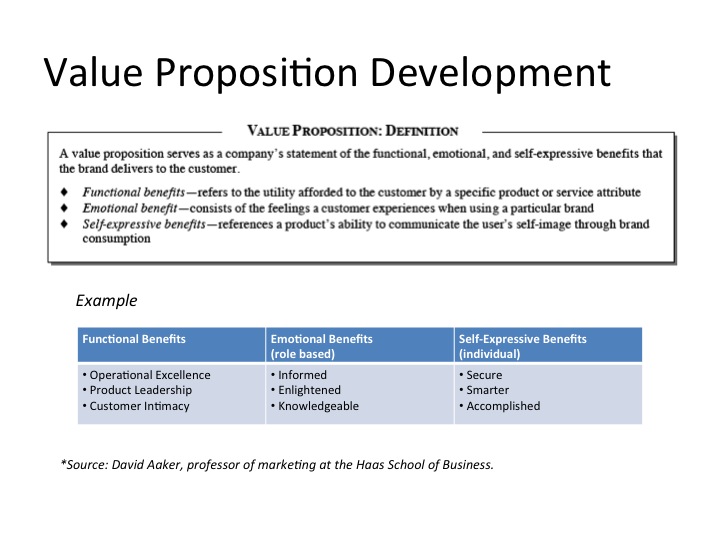
- Make it personal and relevant – David Akers, a marketing professor at the Haas School of Business, defines a value proposition in three parts: Functional benefits, Emotional Benefits, and Self-Expressive Benefits. The functional benefits are related to the step above. Emotional benefits are typically tied the role, and self-expressive benefits to the individual. See below.
- Test, Refine and Validate– start with the sales organization, and then with a few of your customers. This process is not only about capturing the value of your organization through the ears and eyes of your customers, but it’s also a change management challenge. The process can still break down unless the organization “buys-in” to adopting the final output. Customer validation will help “lock it down.”
Lastly, be disciplined – once defined, stick to it for at least a year. Marketing’s role is to clearly communicate the value (organization, product, etc.) to targeted audiences, sales is to convert it into revenue. As a result, sales may take some liberties with the story. But keep in mind, just because someone comes up with a clever new “Why Us Today” story in the heat of a pitch, doesn’t mean you change your messaging. Stay on point, you don’t want to do this 400 times…trust me.
by scott.gillum | Sep 27, 2012 | 2011, Marketing
Original posted on Forbes July 25, 2011
Years ago some colleagues of mine built what we thought at the time was the “holy grail” of business marketing: A sophisticated analytical tool that could tell a marketer where to invest, why, and what the return would be in sales productivity. It could also tell them where to cut dollars, why and what the impact would be on the business.
It was an incredible feat of analytical modeling and technology. Built for one of the most respected and well known companies in the world, so the CMO could answer with absolute certainty the CEO’s question: “What am I getting for my marketing spend?” We thought that it was our ticket to the big time and the rocket to ride to explosive growth, but that was not the case.
It turned out to be the only one we sold. And that always baffled me. Anyone who saw the tool was awed by its power and insight, but they didn’t buy.
Over the years, I picked up some clues as to why others would not buy:
- The head of a major west coast based IT company warned us that our business intelligence tool and analytic model might limit his managers’ ability to make decisions based on their experience … “gut feel.”
- The CMO of a global software company was concerned that our meticulously designed marketing processes, with stage gates and Gantt charts might limit his team’s creativity.
- The head of marketing finance at a major Financial Service company told me that every year they run their marketing optimization model and it tells them that they overspend on TV, and under spend in print. But at the end of the year if there was additional budget leftover the CMO puts it in TV.
I’ve now been able to put the pieces together. I came from a marketing science world and have since learned to appreciate and understand the value of the art of marketing.
Data and analytics can tell you where customers are, what they look like, what they’re interested in, but science alone can’t make customers buy. It can’t make customers advocate for a brand, and it can’t make the hair stand up on the back of their necks.
Insightful, creative and relevant ideas that trigger human emotions can – and do – sell. For as much as I wanted to believe that buyers were rational creatures behaving in predictable patterns, I now understand that they are not.
Marketing, as much as we want it to be, is not an exact science. Technology innovation has allowed us to better understand buyers, influencers and the performance of our activities.
But at the end of the day, business is personal. We can’t remove the human element from the buyer or seller side. Relationships and perceptions matter, how a product and/or a brand makes a customer feel is important, and it’s not easy to model or predict.
And with that, I found the answer: Although helpful and informative, good marketers don’t need to rely on sophisticated analytical tools to make decisions. Their experience, “gut,” and sometimes the hairs on their back of their neck do just fine.
by scott.gillum | Aug 28, 2012 | 2010, Sales
Originally posted on August 11, 2010
Social Relationship Management and Social CRM are terms that are now being thrown around for new technology platforms that are enabling multichannel execution. Companies like Lithium Technologies have created platforms that allow companies to run hosted communities, listen across a variety of social media channels, and manage content to and from social networks in one integrate tool.
While marketing has steadily evolved from “one to many”, to “one to one“, Social CRM is now creating the opportunity for “many to one.” For example, a customer tweets a question about a product (e.g. is it worth the money) on Twitter, a customer advocate brings that comment into the company’s online forum. Customers response to the question by sharing their experiences with the product, those comments (most likely only the positive ones) are then tweeted by the company to promote the product.
The promise of Web 2.0 has always been about customers selling to customers. New Social CRM tools are now enabling that by consolidating platforms. But this has the potential to raise issues over who gets credit for the sale. If the true ROI on social media is revenue, which many research studies are now suggesting, then who should gets credit for a sale closed by a customer advocate?
Customer references and testimonials have always been critical for closing deals. What happens when customer advocates volunteer their support for the brand and/or endorsement of a product? Does marketing get credit for providing platforms for enabling customer advocates? And what about the customer/s who’s comments help push the prospect over the goal line…do they need to be rewarded, and if so?
One thing is certain: social media is blurring the line between sales and marketing interactions and dialogues. Given that, we may have to rethink our traditional views of customer coverage and relationship management. Perhaps in the future, marketing will be responsible for managing customers online relationships, and sales for the offline experience.
Someone call HR and give them the heads up. Territory planning, revenue crediting, roles and responsibilities might need a refresh soon.
by scott.gillum | Aug 7, 2012 | 2010
Original post date August 27, 2010
The amount of “lameness” on the part of some sales people (and some marketers) has now come to a point that I think a public flogging is in order. To those Michael Scott’s of the world (and I like Michael), know that we are on to you. The following tactics have never, and will never, produce a lead.
1. Filling out a company’s contact form on the website with ”contact me if you need…” Yep, I’ll get right on that. (Click on the image below, it may take a moment to build).
Mike, for example, was able to jam an entire spam email onto our company contact me form, impressive. Sure, I will take the time to read the entire message box and get back to you.
But wait, sensing that I might not take him seriously, he submits the form again 2 minutes later.
2. Sending an email blast with the generic intro of “Dear Sir.” Forget everything you’ve learned about 1 to 1 marketing, personalization, relevancy, this just might work. Just get a list, and go.
3. Even better, the telemarketing of version of the “no effort” approach. Cold calling and asking; “can you please tell me who handles…” Instead of you doing your job, you’re now asking me to do it for you — beautiful.
4. Some telemarketers have taken it to a whole new level. Love the folks who leave a message without saying why they are calling, but then ask you to call them back. And my personal favorite — the rep who invented the “I’m returning your call…” It’s like the guy you knew in college that spent hours figuring out how to cheat for a test, instead of using the time to study.
5. Advertising your services in the comment section of a blog. Let’s take Jeff D, he didn’t even try to hide it in a link. He went straight for the kill.
It’s not all bad because he does give me “props” at the end of the ad…”I like your information it is helpful to me.” Mmm, is it helpful because it gives you an opportunity to display spam? Apparently so, because Jeff D comes back 6 days later, this time pimping new services, Website design and development. Notice I get no “props” this time. Pretty tricky changing the name of the company, almost didn’t catch him.
To Jeff D, and all the other spammers, know that bloggers decide whether or not to post your comments. The comments above never made it public, I saved them for my own personal enjoyment, and this blog post. Also, know that Blogspot, as well as other platforms, now have enable spam filters. Good luck on future postings.
6. Posting a discussion within a Linked-in group that isn’t a discussion, but rather, an advertisement for your company…it’s not a discussion; it’s spam, and it’s annoying.
Take Mr. Gupta for example, at Web Box Office. He’s advertising “Learn the secrets to success with attendee-funded webinars.” Sounds good, huh. Guess who’s paying for the webinar…you are, Mr. attendee, if you register.
7. Using the yellow pages as your prospect database. I’m not kidding, people are still using it. Just wait until they find out about the internet.
8. Offering something FREE, unless it is truly FREE. Taking a credit card number so you can start billing a customer after a “free” trial is not free. This is not selling, it’s scamming. There are rules, some people call them laws, governing this practice. See
FreeCredit Report.com for an example of how not to do it.
9. Any email coming from Nigeria, or any other country, offering a fortune if you could just help them by giving them your social security number, bank account number, etc. To good to be true, something for nothing? Any of this ringing a bell? Ok, maybe I’m a little bitter because I’m still waiting for my $1M from the
British Lottery Authority.
10. Actually, couldn’t think of a 10th, but I’m sure there’s one or more out there. I’d love to hear your experiences. Add your “Top 10” story in the comment section, but please easy on the spam. Jeff D takes up a lot of my time.
I know that times are tough, but with the amount of information now available in the public domain, there is just no excuse for these tactics other than…just plain laziness. C’mon guys, kick it up a notch! If not, I’ll be out with the Top 10 sequel or maybe a FREE webinar.


