by scott.gillum | Jul 20, 2012 | 2009, Sales
Original post date March 24, 2009
In August 1999, Selling Power magazine ran an article featuring our firm and the work we’ve done helping clients, like IBM, build new sales channels and increase sales productivity. A few months later, we received a call from the head of a division within NCR asking us to meet with them to see if we could help them with something similar.
The senior executive with whom we met said if we could help IBM we should be able to do this project for them. Excited about the prospect of helping them build a new channel, we agreed and they laid out the challenge:
- A well-known consulting firm had been previously engaged but had failed
- …which left only 41 working days to get the new sales channel up and running
- An internal NCR tele organization was competing for this…which, we would later learn, tried to sabotage the effort…and us
- And finally, we were entering the holiday season…good luck
After collecting the previous project work we quickly went to work on assessing what had gone wrong. It took us a while, but we finally discovered “IT”. Once found, this insight became the key to unlocking success.
Almost ten years later I’ve seen this scenario play out over and over in B2B companies. This is what we discovered.
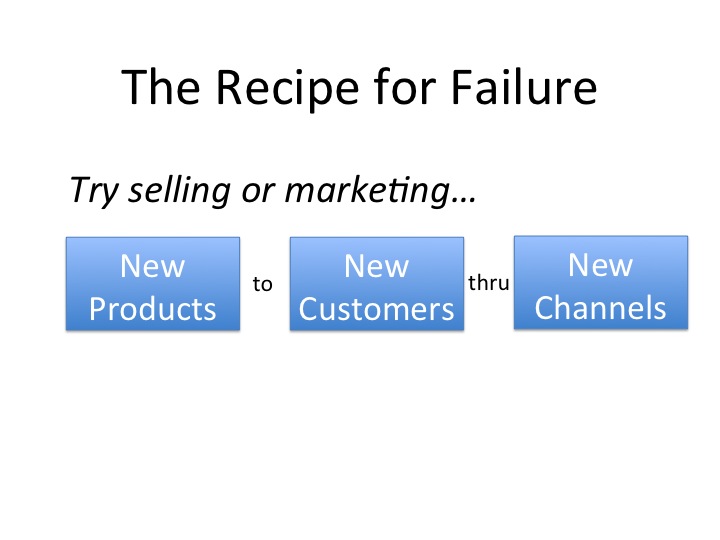
The secret recipe for failure
This simple equation is just as true today as it was a decade ago when we discovered it. Oh, you may find one or two exceptions but the majority of the time when we do post mordem on failed programs you find this equation is at the heart of the problem. When combined with a few related pieces, like a lack of time in the market and/or funding, the initiative is doomed. The degree of “newness” in these three areas will directly impact the likelihood of success or failure.
Sales Channels
- Why they fail – new sales channels fail because companies aim new channels at the wrong targets — new customers/markets. An investment in a new sales channel means that it is competing with existing channels for funding. If it does not hit expectations/goals quickly, it will be robbed of the necessary funding and/or resources needed to make it successful.
- How to improve the chances for success – The most successful way to build a new sale channel is to do exactly the opposite of what is described above. Shift coverage of existing customers or products to the new channel and use your existing channels to go after the “new.” Shift dormant or flat growth customers to the new channel to give it revenue immediately and free up your existing most knowledgeable, best trained sales folks to go after new opportunity.
Marketing Campaigns
- Why they fail – new marketing campaigns promoting new products aimed at new customers typically fail because of reasons listed above…they take too long to produce and/or aren’t given the time. Here’s another common problem, agencies will tell you the problem is the “creative” or “value prop”…maybe, but they also could telling you this because they make money on creative and production. “New” works with their business model.
- How to improve the chances for success – build less individual campaigns and invest more in one or two long term programs with many integrated tactics. Keep the programs in the market longer, closely monitor them and modify tactics based on performance. You don’t need a new campaign every month, you need a program that produces…and with tight budgets this will help you be cost effective/efficient. Years ago we did an assessment of campaign performance at IBM. We found that the highest performing campaigns had at least 7 integrated tactics and stayed in the market for at least 6 months. Use this as a starting point to design your campaigns and programs.
- New to New thru New – level set expectations and invest for the long haul. You will need time and commitment to make it successful. Companies have short-term horizons that are getting shorter every day. If you’re going to lead this effort get everyone to agree on what defines success and stick with your timeline.
- New Product/Service/Solution – try to leverage existing channels, customers or both to start…then migrate to new. This way you can learn if you have the right value prop, messaging, pricing, etc. We like to take existing reps, for example, and use them to help launch a new sales channel, like Tele. We like to use existing customers to test new products, etc.
We got the NCR teleaccount program up and running in 41 days. We transitioned existing field account managers to TeleAccount managers and built their territories around their customers. We then began to backfill them with new lower cost resources over time. You’ll be happy to now that the manager of the group that tried to sabotage the effort got fired.
The program hit our first year sales targets, reduced the expense to revenue ratio from 13% to 6% and grew sales productivity from $1.7M to $3.1M per rep. As a result, NCR then built a full-scale tele channel with close to 80 reps.
Then they killed it. It’s a long story but the bottom line was the company has a strong field sales tradition and culture. Mark Hurd, now CEO of HP, became the CEO of NCR, and decided to shut the channel down, redirecting the resources to the field.
Remember my comment about competing for resources. Mark’s an operations guy and a fan of face to face selling.
Culture runs deep, and can also kill channels and programs. Maybe I should update the “recipe” to include the forth “New”…new leadership.
by scott.gillum | Jul 19, 2012 | 2009, Marketing
My inbox is full of resumes of good marketers that I’ve been fortunate to come to know or work with over the years. Solid people, with great experience who are now having a challenging time finding new opportunities in this incredibly difficult economic environment. Many of these people could have had their pick of jobs as recently as last year. Given the situation, I thought I’d try to help by providing a viewpoint on what skills set, background and experience companies will be seeking once they start hiring again. I’ll use two data sources to make the case.
A few years ago, we teamed up with a professor (
John Josephs)at
Kellogg on a couple of research projects aimed at getting a better understand of what creates a high performance marketing organizations. Internally, we thought of it as the “head” and “body” studies because we first studied the marketing organization (
the body) and then the follow year CMO’s (
the head).
We surveyed not only CMO’s and marketers, but also CEO’s, about their views on what makes marketing effective. The research was then published by the
CMO Council. Here are a few things we discovered along the way.
CEO’s view on how to measure marketings performance
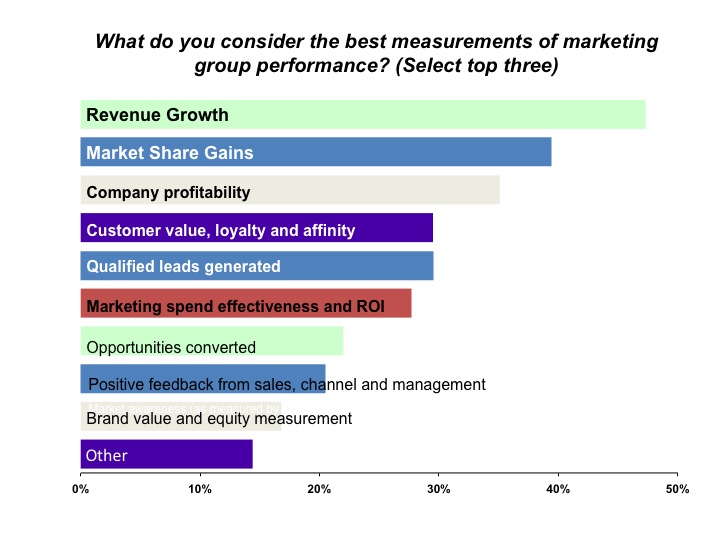
How CEO View Marketing Value and Performance
This information is a few years old now, but I can tell you that based on client work that the down turn has done nothing to change this, if anything, it has placed greater importance on the top 3-4 responses. Keep the top responses on these charts in mind as we move to the next section.
Last month, I was given access to a database of senior level marketers (SVP and up) to do some analysis for the organization that owns it. We looked at the background and experience of over 800 marketers with the following titles:
- 50% were CMO’s
- 32% EVP’s of Marketing
- 8% SVP’s of Marketing
- And interestingly enough 10% had CEO titles but had recently been the head of marketing
They came from large, medium and small companies including start ups:
- 25% – Large (over $500M)
- 32% – Medium ($100-$500M)
- 23% – Small ($50-$100M)
- 22% – Start up or under $50K
We were interested in assessing their area of expertise, experience and tenure.
Although executives with Product Management and Sales Enablement/Demand Gen experience represent only 27% of the total group, they represented a disproportionate amount of executives with the longest tenure. In fact, they were twice as likely (as a representative percentage) to be in the 2-5 years tenure category than those with Brand, Advertising and Corp Comm backgrounds. And they made up half of the individuals in the more than 5 year category.
Another interesting thing we picked up is that markerters in the NYC area were more likely to be new in role versus other regions (higher than average churn…probably attributed to a higher supply of talent).
Spencer Stuart has for many years reported CMO tenure rates (less than the life of a gold fish) but I’ve never seen them look at tenure by background…which makes a difference based on our assessment.
Finally, let’s look at Supply & Demand.
The Top 20 Advertisers in the US have been decimated. Think about…half of the Top 10 advertisers in 2007 were automobile manufactures. As a result, agencies have put hordes of people on the street.GDP in Q4 2008 is estimated to have declined by 6.2% from Q3 that declined by 0.5%. Revenues are down on average of 30-40% from the prior year in most firms (at least the ones we work with).
As a result, there are a slew of marketers with advertising, branding, and corporate comm backgrounds (73% of the database that we analyzed) in the market.
Let’s put it all together:
- CEO’s measure marketing effectiveness by revenue growth and market share
- CMO’s see the greatest need for new talent being driven by the integration of sales & marketing
- A large supply of “above the line” marketers exist in the marketplace
Conclusion– potentially high demand and a low supply of marketers who can drive revenue. The marketers that will be in the highest demand coming out of the recession will be the ones who have been aligned or have had direct responsibility for growing revenue. Marketers that can speak the language of sales. Unfortunately, it will be a slow process for folks with a Brand PR and Corp Comm or the Ex-Agency/Media guys.Marketers with backgrounds in Product Management/Marketing who have owned a P&L, folks with sales backgrounds and/or marketers who can show that they can drive revenue/growth will be in demand first.
The challenge for the other groups is that of supply. It’s not to say that good Brand and Agency folks won’t find positions it’s that it’s going to be hard. Expect that you will be competiting with many other qualified candidates and it may be difficult to differentiate yourself.
by scott.gillum | Jul 18, 2012 | 2009, Marketing
Original post date March 6, 2009
Tell me if you’ve seen this movie before. After spending months debating about the right type of segmentation to do, you finally agree, do the research and…it never gets used. Or how about this one, you get a request from sales for information you’ve already sent to them…multiple times.
It’s a horror movie and it gets play out every day in organizations all across the country. Why is it that we want “data” but then we don’t end up using it? Based on my experiences with clients, I believe it comes down to few common problems that are manageable, if known.
The top 5 problems I see:
-
- Actionable Insight – as in the lack of it…it’s the #1 reason why data doesn’t get used. Far too often the Ph.D’s will put out data without having interpreting it for the intended audience which then sets up the next problem.
-
- Language/Communication – call it taxonomy, communication style, whatever, data folks and everyone else (in particular, sales & marketing) speak different languages.
-
- Overload & Timing – yes, analysis paralysis does exist but not the way you might think. If you’re in a data rich environment, you’ve probably experienced this. Just too much info flying around and as a result, it often gets ignored. It’s not that it causes people to not take action, as much as it is people taken action and ignoring the data. In other situations, especially involving marketers, it may be a matter of timing. They may be in too much of a hurry to get something out the door to wait on the data.
-
- 60-70% Complete – critical pieces are sometimes missing so you can’t see the insight. The dots haven’t been connected. The person responsible for supplying the data doesn’t, and/or wouldn’t, see the connection.
-
- Skill set – CMO’s when asked the top reasons (see the chart in the post below) for the need for new skills in their organizations mentioned; “greater segmentation of market” and “increase demands for analytics” in their top 5. The problem is that there aren’t many of them out there.
Why is this important now? Because everything you do or want to do, or are thinking about doing, will have to be backed by data in this economic environment…you’ll need a rock solid reason for getting, or spending a budget.
Five things to do about it:
-
- Apply the “So What” rule – yes, this rule is typically used to help define a feature from a benefit but it’s also effective at drawing out insight from raw data. If the data guys are presenting information that you don’t “get” ask them “so what?”…as in, what is this data suppose to tell me? And keep asking until you get to the “so what.”
-
- Help connect the Dots – if the story is missing help supply/coach on how or where to connect the other pieces. If you’re the user know what you’re looking for and provide guidance on where to find it. As I mention above, researchers may not know or wouldn’t understand the connection. This also applies to coaching on communication. Help them understand the language you speak.
-
- Chunk it up – sometimes there is just too much to take in and process. Chunk information into more digestible pieces. Take some time and think about what various groups can digest and how often…especially if you’re in a data rich environment.
-
- Provide plenty of lead time and direction – don’t expect to get something insightful and/or useful if you don’t give adequate notice or direction. Getting a report on market share won’t tell you how to increase it, or why you’re losing it. Combining trended quarterly market share, key consideration drivers, and sales coverage will…but it takes time to collect. Know what you’re looking for and how to get it.
-
- Hire an expert – as was mentioned above there is more demand than supply of talented people who can pull insight out of data and drive action from the insight. If you have to, partner with a vendor. It should also help with the timing/speed issue mentioned earlier. Additionally, they will have tools/approaches that help force out insight.
Data…leads to Insight…leads to Action…leads to Data…the cycle of life. It’s time to turn this horror movie into an action thriller.
by scott.gillum | Jul 18, 2012 | 2009, Marketing
Original post date February 5, 2009
What if you could create a trend that could make your product “THE” hot product? Think it’s impossible? Maybe now, but in less than two years it will happen.
I saw something a few weeks ago that gave me chills when I thought about the potential uses. The tool is…in a sense…the world’s largest and most sophisticated digital listening device. It was built to monitor chatter by those “not so friendly” folks that see the US as the “evil empire”. (Let’s just say that Homeland Security has got this one nailed.) Yes, other companies have similar tools but nothing reaches the size, scale and scope of this one (consider this, it has archived ALL the web pages in the ”www” for the last three years).
Anyway, we’re helping to develop a commercial use for the tool and I as was watching the demonstration, I couldn’t help but think about Malcolm Gladwell’s book
The Tipping Point. Many of the concepts he wrote about, I was now seeing play out in real life. This gigantic ear could easily determine who the “
connectors” of the digital world are (in real time), “The Power of Context” as Malcom refers to it (in over 20 languages), and when something is going “viral”….all with very sophisticated algorithms and complex math.
It got me thinking, could it also determine how to create a trend? According to the team that developed the tool , it can’t yet because it doesn’t assess and/or integrate a number of important factors needed to understand the audience and what drives behavior. But if you combine the power of this tool (and other similar tools) and social networking…I believe that we are getting close.
A few days later a colleague sent me this post. Facebook is studying “sentiment” behavior. Right now it’s limited to things like how “nasty news is impacting stock” and when folks are “going out” but it can, and will evolve quickly. To this point, Zuckerberg has not really monetized his platform yet, unlike Murdoch with MySpace.
So could this be the “killer” app that drives Ad sales into Facebook? It’s too soon to tell at this point but it sure sounds good. With
222 million unique visitors sharing very personal information with most of it in the public domain this might be the next piece to fall. Throw in
Twitter and marketers will soon have the ability to understand what’s “hot” or has the potential to be “hot”, who says it’s “hot”, why they’re saying it, where they like to buy “hot”, etc.So the question to marketers is…if you have the opportunity in the near future to make your product the “hottest” thing…could you? You currently have the ability to access massive amounts of consumer data today and that will grow dramatically over the next few years. What are you doing with it now and what might you do with this information in the future?
One thing is for certain, it will require new capabilities, vendors, and tools to interpret and draw out insight. Get ready now, it’s coming… and in this situation there will be a clear early mover advantage.For now, go back and re-read The Tipping Point (replace Hush Puppies with UGGs) and start dreaming about the possibilities, especially what it would take to make it happen. Think about this for a second: you could start a trend for a product that doesn’t exist…demand before supply…yea, that’s “HOT.”
by scott.gillum | Jul 16, 2012 | 2008, Marketing

Original post date November 3, 2008
Click on the image above. Now this is how you market in a down economy. Over the past year I’ve focused on the virtues of Web 2.0, but it’s time to give a “shout out” to ol’ school direct marketing, especially when it’s done this well. It’s from Boden, a children’s clothing catalog company.
This letter is a virtual clinic on how to do DM right. Things to love about this piece:
-
- Quick Service Number – immediately connected to my account info…they know me as a customer…and that I’ve bought (a lot apparently) in the past. Most likely, it also serves as a tracking code. Bonus incentive: if I use it when I call I will receive free shipping, which would probably be the case anyway but they’ve given me an incentive to give them the tracking code.
-
- The Opening Sentence/Paragraph – it’s about me (actually, my wife) right out the gate. You’ve maybe got 2-3 seconds to connect with the reader nowadays, and you can’t start out with what you want or who you are because the reader doesn’t care. I also know what you thinking, how is it that your wife shared a letter like this given the comments that we bought “armfuls” last year and we were “one of their best customers.” Two reasons; 1) she’s an ex-agency person and appreciates a good piece like this, and 2) the letter mentions that we’re not buying as much this year…there’s the positive spin.
-
- Use of Levity/Comedy – this is extremely hard to do well and it is a bit edgy but I love it…makes you want to read more. The use of British humor (this is a UK based company) also adds to it. Folks have been saying for a while that the best creative has been coming out of London. Got to admit I’m seeing more and more evidence of that…but I also have to giving credit to the Geico Gecko (the Martin Agency) for paving the way here as well.
-
- Personalization – from the owner/founder Johannie Boden herself. Have no idea what her first name is or even if she’s even a real person… could be Tommy Bahamas’ sister for all I know, but I like the personalization. Hands down, DM from an individual to an individual always has the best response rates. Writing good copy that sounds likes it’s coming from a real person and not just a signature, that’s another story…maybe even another post.
-
- Customer Buying Behavior – they’re obvious tracking and have noticed a change in my wife’s habits; this is critical in a down market. Watch your best customers and their transactional behavior…probably should have started last year but it’s never too late.
-
- The Solution/Offer – Look up DM best practices and “the experts” will tell you that you should test multiple offers… 50% off, half off, or buy one get one free, and you should, but in today’s economy real dollars savings is a real winner. Simple, tangible and it can be combined with other promotions. “Ol’ whatshername” came up with a custom solutions just for us. She determined that the most likely reason we haven’t been buying lately is price –and she’s dead on…their cloths are on the high end. Back to school this year meant going to Macy’s with a hand-full of 10-20% off coupons.
-
- Limited Time Offer – yep, got to have it. And the time period is getting shorter and shorter. Seeing an interesting trend with the use of limited time offers. This use to be the go to “hook” for PC manufactures and mass merchandisers now I’m seeing it in all kinds of retail situations, and most interesting is it’s use in fund raising. Mobile opens up a whole new dimension look for that next year on Google’s G1 phone. Instant offers feed by GPS that expire very quickly…use it now or lose it.
-
- Creative – notice that the offer gets a third of the page, and is very colorful with offsetting large and small images. The $20 offer is supersized and next to information on where to redeem it. Your eyes are drawn to it immediately and it’s the motivator that determines whether you’ll invest the time to read the text above it. It is also perforated and complete, so if I only read the offer and tossed the top, I would have everything I need to understand and use it. Notice how they personalized the offer…”…I run out soon.” Love it!
At the end of the day the ultimate measure of good DM is performance/results. In my house, it killed but then again we were an easy target…they knew us all too well.


