Let us know what you think. Are outbound sales dead? Do leaders use technology as a ‘silver bullet’ to try and fix sales, marketing, and the customer experience?
The NFL season has begun and three games into the season Kirk Cousins is once again one of the top passers in the league. This is a position he’s enjoyed consistently over the last three seasons by throwing for more than 4000 yards a year (becoming one of only 11 to do so) as the quarterback of the Washington Redskins.
Given the success, most quarterbacks would have been content to stay in an offensive system that produced those results. Cousins, backed by his stats, moved to Minnesota in the off-season, signing a history deal guaranteeing him $84 million over the next three years. Why did Cousins change teams? Because he had leverage. Kirk knew he was a consistent and proven performer in a very tight market for experienced quarterbacks in their prime.
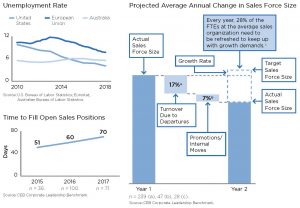
At a recent Gartner meeting, Brent Adamson presented information on the US labor market, along with an outlook on the demand for sales executives. As the chart below illustrates, sales organizations (on average) have to replace a quarter of the sales force each year, in what is now a very tight labor market. In fact, it now takes an average of 70 days to fill a position, an increase of close to 20 days over the last two years.
Given these facts, is it time for proven sales executives to become free agents, like Kurt Cousins? Consider this …Cousins made $44M his last two years under the franchise tag. Making close to $24 million last year, which is more than he will make this year under his new contract. For Cousins, this wasn’t just about the money. He also wanted out of Washington, a team he viewed as never really wanting him (Cousins was drafted in the 4th round of the 2012 draft by the Redskins after taking Robert Griffin III with their first pick).
Consider these two points as you think about your career. You may be making great money but are you in an environment that makes you feel valued or wanted? For a short period of time top performers have leverage in the market.
Another consideration, the other members on your team. Is your bonus tied to the performance of the team, or the company? Cousins chose Minnesota over a richer offer by the Jets because it gave him a better chance at winning a title. Minnesota not only has many offensive weapons but it also features one of the best defenses in the NFC. Is there another team out there that could offer you a better chance of success, not only now, but also in the future?
One thing is certain, the market will change. For now the demand is high and the supply is low for top performing sales executives who can consistently deliver results. Currently, there are over a million open sales positions listed in Indeed.com, close to 200,000 alone with salaries of $70,000 or more. As they say, “sales is a numbers game.” Maybe it’s time to find out what your number is worth.
The experience of selling our house has been a good reminder of the importance of goodwill in the negotiating process.
We were fortunate to get a couple of offers on our home. Hearing feedback from our neighbors and realtors, we learned that one couple with young children really loved our home, especially the trampoline in the backyard!
As we responded to the offers we made it clear to the realtor of a family with the young children that we really wanted them to have the house. Our children, now in college, were a similar age when we first bought the house. The neighborhood was a great place to raise kids and we thought it would be nice to “complete the circle.”
And that’s when the trouble started. Our counteroffer made it clear that we were negotiating in good faith trying to meet the couple in the “middle.” Except they didn’t. They stood their ground forgoing the traditional comprise an approach to pursuing a “we win, you lose” stance. As an emotionally charged seller, I can confirm that this tactic did not go over well.
The disconnect was that we were selling a home full of memories which we wanted to pass along to another young family. As the buyers, they were just making a purchase decision at the best price as possible. It was a transaction for them. And with that, they took out all of the goodwill.
For example, the family was moving to the area from out of town. We’ve lived in the area for thirty years, 14 years in our current location. There are things that would have been helpful to know about our home, our neighborhood and our community. Our children attended the school their children will mostly attend. Played on the soccer fields, and in the school gyms where their kids will play. Insights from a resident on teachers, coaches, neighbors are usually helpful to someone new to an area.
Because they changed the rules of the game none of that conveyed. The relationship had been killed. Think about that when you’re negotiating a business deal. Deals are made between humans so emotions are involved. In the end, you may get your price but at what cost? What goodwill may have been lost? What could the seller tell you that could help with implementation, use of the product/service, etc.
The secret to a good deal is that both parties feel like they gave up something but that they also got something in return. You may feel good about the short-term gain — but by making the other party the “loser” it might cost you in long run.
Last week Tibor Shanto from Renbor Sales Solutions mentioned in his post that I questioned the value of the sales organization. Given the information shared with us at the CEB Sales and Marketing Roundtable meeting we attended, the question was relevant. He goes on to state that what I was really asking is why are so many sales reps struggling and what could marketing do to help them succeed. If the sales organization struggles, most likely marketers will struggle, and they may be the ones who will get the blame.
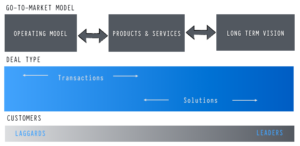
The more I thought about it the more convinced I became that the issue goes beyond sales and marketing, and their ability to correct it. I don’t think marketing can fix what ails sales, and vise versa. To illustrate the issue, I have created a framework that oversimplifies an organization go-to-market model. The core of the GTM model is the operating model, the product and services group and the organizations long-term vision.
Each part of the model plays an important role in determining the success of an organization. Additional detail on each group is contained below.
Operational Model – the core of the business, how it delivers value to customers. It is also focused on driving efficiency and effectiveness in the delivery model.
Product/Services – the physical manifestation of the value.
Vision – how the company articulates their view of the world, now and in the future based on consumer/customer, competitor and market trends and needs.
Marketing develops and articulates the organization’s vision. It should be forward looking (at least three years), and challenge the product organization to “catch up.” It should enable the sales force to sell new solutions, enter new markets and differentiate the organization against competitors.
The product group builds, tests and perfects products, services and solutions that meet the needs of buyers today, and in the future. It should be able to define the market opportunity and the best route to capture it.
The “operating model” should be constantly evaluating those products and services most strategic to the organization (revenue, profit, etc.) and how to scale them. In some of the best organizations I’ve seen, this group enable the “visionary” solution sales reps to sell whatever they want early in a “wave,” as it works to pair down offerings to the few that are the most desired (market demand and/or profitability) As a result, choice, selection and pricing are simplified which helps them scale and enables the sales force to sell efficiently.
Aligning The Sales Organization
Solution Sales team – the solution selling team should be aligned to the front end of the go-to-market model. They have the capability, experience and navigation skills to configure and sell the vision and complex solution, both to internal and external audiences.
Product Specialist and Account Management teams – AM’s or PS’s are aligned to existing accounts and/or products and may be aligned by industry or type of solution. Their goal is to keep and expand the account. Reps that excel in this role are adept at understanding how to navigate the internal workings of the client — how to work the procurement process, position their products/organization against competitors, gain access to new buyers/opportunities, and how to anticipate future needs.
Telesales and Online Portals – the back end of the go-to-market framework where the “operating model” has shifted low margin “simple” products, to align with knowledgeable buyers. Allowing them to make a purchase transaction at the lowest cost and in the most convenient way possible. Sales reps may also dealing with “laggard” first time buyers who come late to a product or solution and have simple requirements.
Marketing’s role across this continuum varies. For the solution sellers, content marketing is critical and as Tibor states “insights built around business objectives.” Marketing has to help the sales organization articulate the organization’s vision (“air cover”) and the value of the product to the buyer, professionally and personally.
So what’s different about the sales model I laid out? Nothing. Does sales need a new model? Maybe, maybe not, but what it needs right now is the organizations commitment to executing the model that I just described. It isn’t throwing more resources and technology at sales, as the CEB research points out. Almost all (98%) of the sales leaders surveyed by CEB had added resources for sales support over the last four years, yet 76% of sales reps said that they have experienced an increase in the complexity of the support they are receiving.
Organizations have to commit to being good at all parts of the go-to-market model. Many of the organizations shortcomings and/or dysfunctional behavior become sales inhibitors. For example, organizations that are operationally efficient often lack the ability to articulate a long-term vision. On the other end, companies that have their heads in the future often miss simple things like scaling down the number of products sold, or simplifying financing terms or compensation plans.
What I took away from the meeting is, in today’s complex business environment, those organization that can simplify buying will win. The problem is that it’s easier to add and feel like you’re making a difference than it is to subtract or reduce and know that you making progress. It’s time to stop feeling like you’re making a difference and start putting a shoulder to making it happen.
Having a hard time convincing “the powers that be” to invest in the brand? Ever wonder why it’s so hard, why all they want from marketing is leads? Let me explain.
In organically grown companies, an organization develops a product or service and goes to market through a sale channel, either owned or via a partner. At this point, the organization is focused on acquiring customers and generating revenue. With low market awareness the organization typically has more sales capacity than demand for its products or services.
If marketing exists, it’s in its infancy, and plays a tactical role developing sales material, supporting business development activities, and it may have a small social media presence.
To fuel the company’s growth, the management team begins to realize in order to make sales and revenue objectives it has to be able to create demand beyond what the sales channels can generate on its own. As a result, marketing expands beyond its most basic sales enablement role into being responsible for generating leads.
When growth slows and/or begins to plateau, the executive management team will (or should) begin to explore the value of “strategic” marketing. Unfortunately, these strategic marketing activities and investments aimed at broadening awareness of the brand are often misunderstood and/or dismissed all together. Here’s why they shouldn’t be, and why they are critical to unlocking a company’s next phase of growth.
Why it’s so hard getting to “Yes”
The challenge in convincing the organization that marketing can be a strategic growth level is one of perception. Because marketing evolves “bottom up” as I just described, the common perception among executives is that marketing is a “tactical support” function.
The second issue is the messenger. The staffing needs of marketing in its infancy are simple, and usually satisfied by an entry-level hire or someone without a marketing background. Rarely, will this person rise to a senior management level. Achieving senior executive “gravitas” is critical for changing perception among the senior management team, especially if the company has a strong sales and/or product culture.
How to win the battle
To convince executives, you have to tie brand investments back to something “tangible.” Your argument has to show a direct connection to an organizations performance, be it sales, profit or the customer. And, if you can improve your message, you will also improve how your executives view the messenger. Here are three areas to explore.
A strong/valued brand lifts price point. Are reps constantly complaining about being beaten up on regarding cost/price? A company that has a strong brand can command a price premium. Years ago, I did some work with competitor of Cisco and found that the Cisco brand had a price premium of 7% over the competitors. Why? B2B purchases are high risk, and as a result, are emotionally charged. Buyers that connect personally to brands are willing to pay more for their product if they believe it will reduce the risk of a bad decision. Need proof, click here.
Improving top of the funnel performance improves the performance of the entire pipeline. Need to increase leads? You have two choices, expand the top of the funnel, or increase conversation rates. The best solution is to do both. By expanding the number of prospects aware of your product you increase the number who will also consider it, which increases the number of opportunities, leads and wins. If you only focus on increasing leads, you’re stuck with improving conversion rates, which may be much more difficult and/or costly.
Brand building doesn’t mean you need a big budget. The fact is you’re doing it everyday, for better or worse. Every conversation a sales rep has with a prospect creates a brand impression, every unresolved service call to the contact center has the potential to damage the brand. You can make great strides by clearly and consistently communicating what the brand stands for both internally and externally. Once defined, put it into the language of your audience in the simplest terms possible. Complex, “consultant like” words and terms are meaningless. The really smart folks simplify the complex.
Now that you’ve made the argument, it’s time to close the deal. When an executive evaluates a proposal from your company against other competitors, do you know what tips the scale in your favor? No, it’s not price, or the “relationship,” it’s your reputation, your brand. It’s how they feel about your company…and that’s not in your proposal.
Did you know, that until recently restaurant owners only cared about the cleanliness of the food prep area? Most customers, and owners, assumed that if someone got sick after dining out it was because of food poisoning. That was until Carbon Design and Challenger Inc. helped “challenge” the norm by showing owners that half of the outbreaks in a restaurant were caused by people to people transmissions.
Now owners know where the “hotspots” are, and as a result, restaurant are cleaner than ever. Grab your face mask and enjoy a safe night out, but you may want to avoid the raw oysters 😉.
CASE STUDY
How do you do it? By giving clients and users what they want. Using the remaining budget that was to be used to update the site with the new branding we designed and built an entirely new site on a new platform. But audience needs are constantly evolving so the work never stops. Our team continues to audit performance and make improvements.
As a result, the two-year journey has paid off with the site being named #1 in the industry. Even more importantly, their key priority areas (site search, attorney profiles, etc.) were ranked in the outstanding category. Proving that excellence is a journey not just a destination.
CASE STUDY
It’s not unusual to find companies referring to their relationship with clients as “partnerships.” It’s common to find client logos on vendor websites. But how often do you see an agency or consulting firm’s logo on client websites? If you visit www.evepark.ca – that’s exactly what you’ll see.
Carbon Design, represented side by side with, a global architecture powerhouse, a world-class designer, and the project principal: the innovative green-tech engineering firm, S2E Technologies Inc. Under S2E’s leadership, these firms are inventing a new consumer category – one that integrates bold new ideas about housing and transportation – and radically resets the carbon footprint of both at the same time.