by scott.gillum | Oct 29, 2015 | 2015, Sales
My first job out of college was selling office equipment. The first thing I ever learned about selling (from my very Southern sales manger) was that “Telling ain’t selling.” In layman terms, stop telling customers why they need your product and start listening to their needs.
For years this simple phase remained in my memory. It guided me as a way to engage prospects in advisory-like sales dialogue, probing for a need to sell to. But, after attending CEB’s Sales & Marketing Summit last week, where new research highlighted the increased complexity in reaching a purchase decision, I’m now considering rethinking my whole approach.
Why? Because buyers have become overwhelmed by the potential choices, 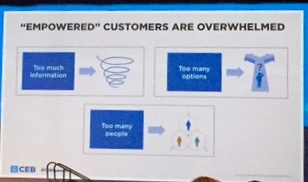 and the involvement of other decision makers in the process, according to Brent Adamson, co-author of The Challenger Customer. Too much information, too many options and too many people involved in the process are making it more difficult than ever to reach a consensus, let alone a purchase decision. Given the complexity, stalled deals are no longer a sales issue; they’re a buying problem.
The question is: Are marketers contributing to that problem? Is it possible our content marketing efforts, aimed at helping buyers make an informed choice, are becoming part of the “too much” problem? According to Psychologist Barry Schwartz, author of The Paradox of Choice, too much choice often results in no choice at all.
Dr. Schwartz’s research has shown that limiting choice is often necessary to reach a decision, and/or to speed up the buying process. As he said, “When you make choice easier, or more simple, you will sell more.”
For business-to-business sales and marketers, the key is to become “prescriptive,” according to Adamson. Customers need a “trusted advisor” to help guide them through the complexity of the decision making process, in particular in driving a consistent point of view on the problem, and the best solution. Schwartz suggests focusing on the following three areas:
- Be the “expert” or “simplifier.” Help reduce the complexity of the problem, process and/or solution. Smart content should help to explain and simplify solutions to complex problems.
- Create an “anchor.” Help customers understand how to assess the value you offer. Buyers may have a hard time assessing the true value of a new purchase or a new vendor. Help them by giving them context. Find a relatable anchor comparison. Think: ”Platinum service at a standard price.”
- Understand the impact of “no decision.” If no decision is the right decision, then find a way to make it the default answer. This approach is commonly seen in software or subscription-based services where membership/licensing automatically renews.
Do we now dictate to customers/prospects? Not according to Schwartz. Asking probing questions that lead customers to convince themselves that they need your product is the path to goal attainment. Help them understand how your product/service uniquely solves their problem by guiding their path to purchase.
The words of wisdom given to me years ago were right, but given today’s increased complexity it needs an updated “Telling ain’t selling…until it is.”
by scott.gillum | Jan 4, 2015 | 2015
It’s the time of the year to look back over the last 12 months and create a “best of” list. This year I’ve pulled the most popular posts from five different sites; Adage, Business2Community, Forbes, Fortune and LinkedIn. In addition, I’ve thrown in a few other noteworthy nuggets from the year at the end of the post.
Adage – Why Apple Pay Could be Huge, And It’s Not What You Think explored the potential upside of Apple Pay as an advertising platform. It sparked the most conversation, and debate, on Twitter. Time will tell if they this strategy will come to fruition.
Business2Community – 5 Key Tips and Da ta Points to Defend You 2015 Marketing Budget. The last post of the year required the most man hours, and it was the most reposted story of the year. It offers marketers help with their 2015 planning activities in the form of free research and benchmark data.
Forbes -the most popular and shared post of the year, Could Falling Test Scores Be a Good Thing for the US? explores the link between test scores and success in business. It also highlights the risk associated with over emphasizing left brain analytic skill development, outlined by Sir Ken Robinson in his Ted Talk video Do Schools Kill Creativity? The endorsement of Marc Andreessen certainly played a big role in the popularity of the post.

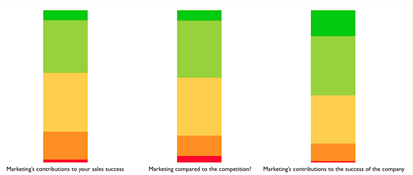
Fortune – Are Marketers Measuring the Right Things was the first post I wrote for our new partnership with Fortune. It profiles the efforts of Ciena, a networking company, to elevate marketings role, and importance, within the organization. The post highlights an unique survey tool used to gather feedback from the sales organization on the performance of marketing (see the dashboard below).
LInkedIn – 2014 marked my first year publishing on LinkedIn. Based on my experience so far, I’m not convince it will viable platform for content unless it becomes better policed. Too much promotional material seems is making its way on to it. At this point, I’m not sure I’ll continue to post.
That said, the most popular post on LinkedIn was also one of the most popular on Adage. The Keys to Differentiating Your Company From Others provides tips on how marketers can humanize their corporate brand to better resonate with audiences. It also identifies one of the common flaws of B2B communication – thinking that what you sell…is who you are. Hopefully, it also helped generated a new client for a follower.

Bonus Stuff
A couple of other noteworthy happenings from the year.
Moving on up.
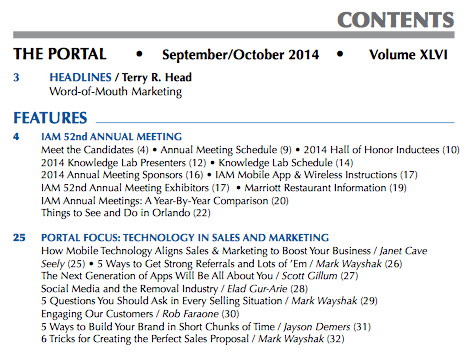
The Next Generation of Apps Will Be All About You post that ran on Advertising Age was reprinted in the Sept/Oct version of The Portal magazine, a bi-monthly publication produced by the International Association of Movers.
 Taking Center Stage
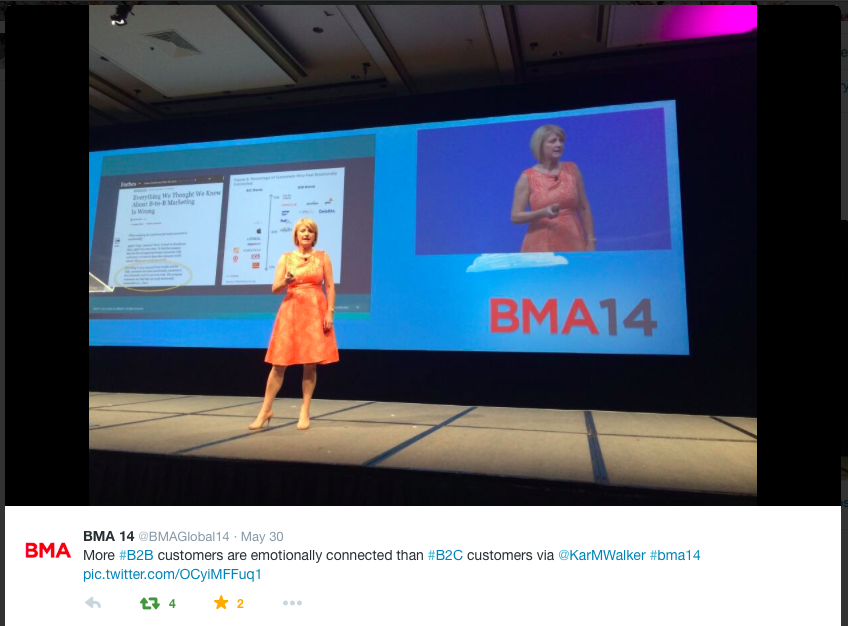
Karen Walker, SVP at Cisco, highlighted my post Everything We Thought We Knew About B2B Marketing is Wrong in her presentation at this year BMA member meeting in Chicago. The post now has close to 70,000 views.
Happy New Year! Here’s to an exciting year to come.
by scott.gillum | Aug 5, 2014 | 2014, Sales
The team killed it. The presentation was flawless. The proposal was outstanding. You covered all of the bases, but you lost. Searching for answers, the only thing you can think of is that the other guy must of “bought the deal,” right? In the article entitled; Why B2B Sales Leads Don’t Convert (and Who Is to Blame) Marketing Profs.com highlights a recent survey of close to 200 marketers, sales professionals, and president/CEOs on their thoughts on why deals were “lost.” Not surprisingly, 60% said that “price” was the main reason, but what may surprise you is that percentage is wrong. 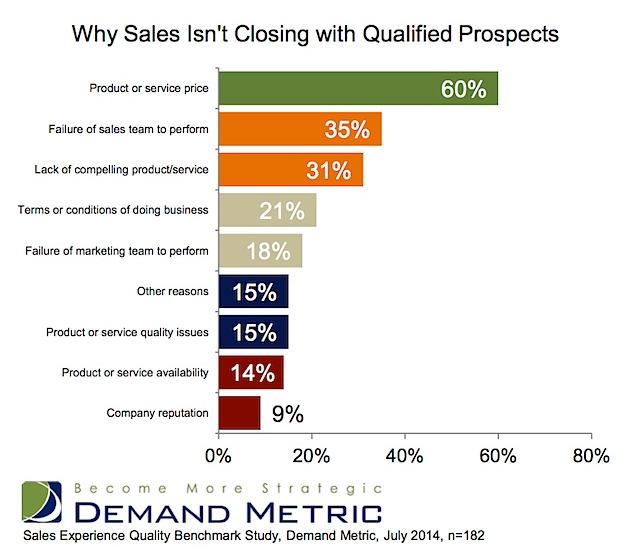
To truly understand why deals are lost, you have to get feedback from buyers. Having conducted numerous post mortem analysis of lost deals, and buyer behavior research, here’s what I have learned. Roughly one third of all buyers consider price as one of, or the main driver of a purchase decision. Pure price buyers represent about 5-10% of all decision makers. The remaining portion (20-25%) are value buyers who may, but don’t always, buy the lowest priced product or service. Using those numbers, the research overstates “price” as the reason for a loss by a factor of 2X. What accounts for the remaining thirty percent? Here are three common reasons for losing a deal, that doesn’t involve price.
- Low investment in the relationship – deals are not solely rationally made purchase transactions, especially as price and product complexity increases. Selling bigger ticket items involves a degree of trust built between a vendor and a buyer. Recent research by Fortune and gyro found that 65% of executives believe subjective factors that can’t be quantified (like a company’s culture and values) make a difference when evaluating competing proposals. Even more executives (70%) said that a company’s reputation was a critical consideration in the decision making process. Investing in relationship building with buyers takes time but as the research shows, it’s worth it. If buyers say that the only time they hear from a rep is when he/she wants to sell them something…that investment is not being made.
- Focusing on the wrong message – focusing on only selling the business value (functional benefits, business outcomes) of a product limits sales ability to make the case for a higher price. Connecting the value the product delivers to the buyer, on a personal level, helps reps broaden the conversation. According to CEB research, not only are you twice as likely to win the deal by focusing on personal value drivers
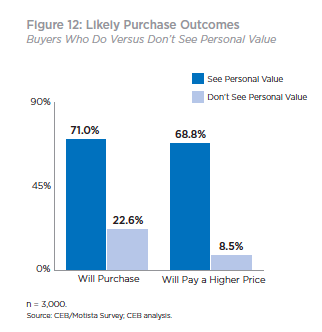 (professional and personal benefits, like a promotion, admiration from peers, etc.), but also, buyers are eight times more willing pay a premium. To do this effectively sales people need to be able to put themselves in the shoes of decision mak ers. They need to understand their buyers’ situation, role, relationships, etc., and sell the value of the product or service to those unique needs. If reps only know how to sell “feature functionality” the conversation will all too often come back to price.
- Missing the real buyer – there is no guarantee that past buyers will be key decision makers in future purchase decisions, or on other types of products. Years ago, I did a post mortem analysis for a medical equipment company on an innovative new product. Sales said they were losing deals because it was priced too high. The analysis proved that they were both right, and wrong. The traditional buyer, did in fact, believe that the product was priced too high compared to others in the market. But a new set of users who had become the primary decision makers had emerged. This group was using the innovative technology as a revenue generating procedure. As a result, they valued the product differently and were willing to pay a premium. Deals were lost because the company didn’t understand how buyers intended to use the product, and as a result, they missed the key decision maker.
The simple answer is that deals are lost because the case for the value of the product or service has not been adequately expressed to meet the needs (professional, personal or both) of the key decision maker. Blaming “price” is a convenient crutch that shifts accountability to the product or pricing team, and away from sales and marketing. Finger pointing may make us feel better about our role, but it doesn’t fix the problem. If you are truly intent on increasing win rates dig deeper into understand why, I can guarantee you won’t find that it is “price” 6 out of 10 times.
by scott.gillum | Jun 10, 2014 | 2014, Marketing
Tell me if you have heard this before; “we need more, and/or better leads.” The chances are, if you’re in hi-tech marketing you may hear it on daily, weekly and monthly basis. Why? According to Forrester consultant Tom Grant, it’s because of the need to feed the funnel.
In his report Tech Marketers Pursue Antiquated Marketing Strategies Grant compared hi-tech firms to other industries “B2B technology companies treat marketing as an opportunity to sell new products and services to new customers.” As he stated “the product is the axis around which marketing efforts turn,” and as a result, the primary objective of marketing is to produce leads.
Similarly, marketers have long held the belief that because of sales short-term focus on making quarterly objectives, it either lacks the appreciation of, and/or the sophistication to understand anything other than lead gen, for example longer-term brand building and awareness activities.
But what if both of these viewpoints were actually wrong. What would happen if you asked sales what they valued, rather than assumed you knew the answer? How might it change how marketing thinks about its impact on the organization?
For one B2B Tech Company, feedback from the sales force is helping them refine their value to the organization. “When it comes to enabling the sales force, we’ve previously relied on what I call “measurement-by-anecdote.” Our goal with this study was to quantify what sales values from marketing so we can focus on the things that make a difference.” said Rick Dodd, SVP Marketing of Ciena, a $2 billion global optical and packet networking company.
To gain that insight the company surveyed its global sales force, including five types of sales reps covering five different account types. Over 400 sales reps provided feedback on their priorities for marketing and marketing’s performance.
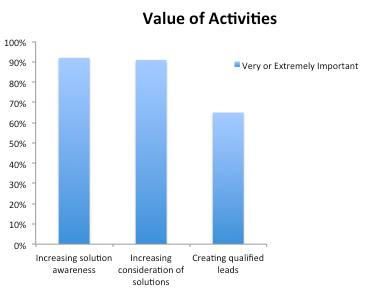
According to sales, the highest ranked marketing activities were at the top of the funnel, 92% of sales said that increasing the awareness of solutions was very or extremely important, increasing consideration was close behind at 91%, only 65% mentioned lead generation.
“Our sales force is very experienced; they understand that technology and industries change quickly. We’ve obviously been successful positioning ourselves for today’s market, and now we want to take best advantage of the big shifts in our landscape. The survey showed us that for sales to be successful, marketing has to be able to change customers and prospect perceptions,” according to Dodd.
Perhaps the most interesting insight to come out of the research, is how Ciena is now thinking about measuring and reporting marketing’s impact on the organization. “Measuring pipeline value is a struggle in our business”, said Bill Rozier, VP of Marketing. “We have long, complex sales cycles that make it difficult to isolate marketing’s impact.”And they are not alone it in that challenge. The Aberdeen Group’s recent Demand Generation study found that 77% of respondents rated visibility into lead performance across stages as very valuable, but only 43% indicated they can do thi effectively.
Instead of spending a lot of time and energy in trying to perfect an imperfect process, thecompany is focusing efforts on measuring marketing performance at the macro level. “At the end of the day, our performance is ultimately measured in sales success, so that’s what we are focusing on measuring”, said Rozier.
To do that, the company has created a quarterly dashboard from the survey. Two regional sales organizations each quarter will be asked to evaluate marketing’s performance in three areas: 1) Marketing’s contribution to sales success; 2) Marketing’s performance compared to competitors; and 3) Marketing’s contribution to the success of the organization.
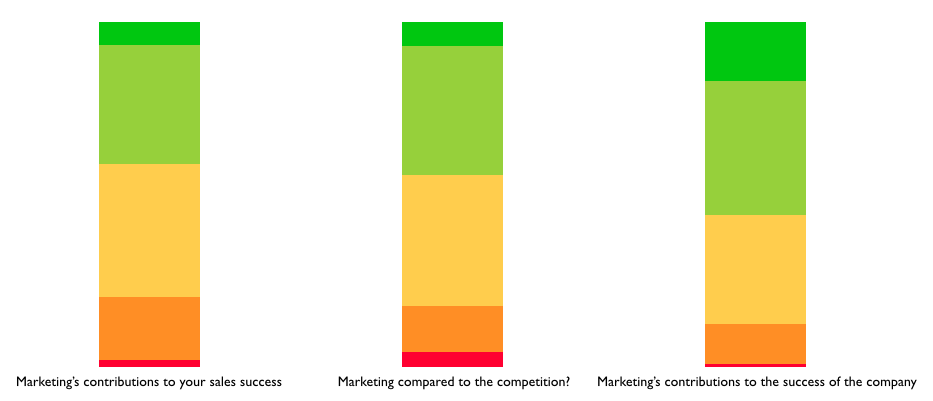
It’s a unique approach, and perhaps one that should be considered by others, because the challenge in performance management is often in defining the right metrics to drive the intended behaviors.
Ciena’s approach, as Dodd concludes, is to put the focus on the right conversation; “As we learned through the research, contributing to the success of the sales force isn’t just about one thing, it isn’t just lead gen. I appreciate that they give us credit for doing a good job when compared to competitors, but what we’re most interested in understanding is how well are we doing in enabling them to win. If the sales team rates our contributions as being valuable to their personal success, then we know we’re doing the right things.”
by scott.gillum | Dec 2, 2013 | 2013, Marketing
My initiation into the world of sales happened at the height of the “Glen Garry Glen Ross” days. It was the time of “blue suits” and “fast talkers”, and not a piece of sales automation or tracking technology anywhere to be found.
We’d roam our territories searching for conversations hoping it would lead to something more. At the end of the day, we’d return to the office and put our “numbers” up on the board; # of conversations, # of leads, and closed deals ($). The white board was our “sales dashboard” highlighting performance against goals for the month, and year-to-date. Our view, and control over our success, was determined day-to-day.
Over the last 25 years, sales has been enabled with a broad set of new technologies, from sales force automation to CRM to cloud based mobile sales tools. All aimed at helping the sales organization better track, measure, and achieve quota. And with each advancement in technology, sales has gained the feeling that it has more control over the process, and outcome.
The buyer’s journey is marketing’s “shiny new penny”. Over the last couple of years, numerous consulting firms have produced research trying to map the journey with varying estimates on how late in the journey customers are now engaging sales.
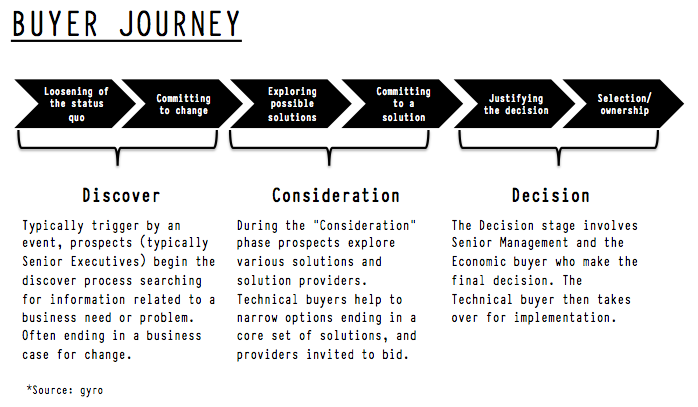
Before you go off preaching this newfound perspective on how buyers are now in control to a sales organization, who might just have a counter viewpoint, there are some things you need to know:
- This is not necessarily “new” news – educated buyers have been engaging late in the process for years, and in some cases, bypassing the sales reps all together ordering direct. What’s different now is that we have better tools to track their behavior.
- It can be threatening – sales folks “cover” buyers, be it a prospect or an existing customers. Their job is to start a conversation and to continue the discussions to, hopefully, a successful outcome. They can’t be everywhere, or everything to everyone, but to suggest that they are not providing buyers with the right information at the right time, or that they may not be “covering” them will cause a defensive or hostel reaction. Be tactful in the way you present the findings.
- Buyers channel surf – don’t assume that buyers are only online in the early stages of the buyers journey, and likewise, that they are only talking with sales in the late stages of the process. Unlike the past, when we could estimate where customers were in the sales process by watching how they engaged with content and channels, buyers now use all channels, and all information sources, at all stages of the journey.
- Good sales people already get it – good sales people are very intuitive by nature. They already have a feel for how buyers research and purchase products. They also know how to use the best content and/or tools to help buyers advance their learning and to move the process. As a result, they will want to know how you can help them.
- Have a Plan – especially for the sales people I just mentioned. The question that you should expect to get after sharing the information is; “So what now? Given this new insight how should we change our sales and marketing approach.” Make sure you have an answer.
My gut reaction was that the buyer’s journey would pose a significant change for sales, I now realize that it’s a much bigger challenge for marketing. Given the amount of time spend online in the research phase, buyers already have a good feel for the “business value” of your product or service by the time they engage sales. It’s why they have put your organization in the “consideration set.”
The challenge, according to recent research, is that buyers are unable to differentiate your product or service from the 3-5 other companies they are also considering. To create separation, you must be able to illustrate and communication “personal value”.
And that has not been a strength of marketing, but it’s a core competency of good sales people. Use this opportunity to partner with sales to developed content that resonates with buyers on emotion level deeper into their journey. Sales may be losing control over the buying process, but they know how to connect on a personal level with individual making the purchase decision, use that to your advantage.


